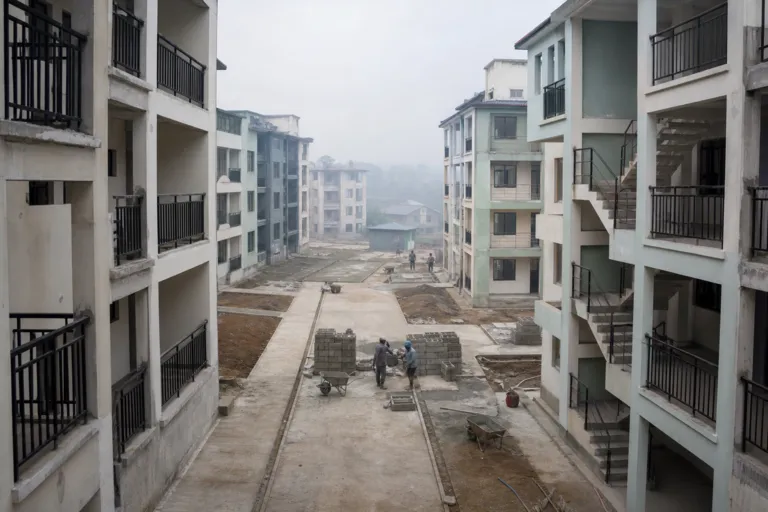
Low-cost and social housing development in Myanmar in 2026 is shaped by a clear split: demand is strong, but delivery is complicated by inflation, currency volatility, and limited mortgage financing. Mordor Intelligence estimates Myanmar’s residential real estate market at USD 1.71 billion in 2026, up from USD 1.58 billion in 2025, with projections reaching USD 2.56 billion by 2031 at an 8.35% CAGR (2026–2031). Within this broader market, affordable housing already holds a 51.85% share of residential market size in 2025, which anchors the pipeline for lower-cost unit types and supports the business case for scaled housing programs.
City dynamics matter because the gap between formal supply and practical demand is most visible where jobs and services are concentrated. Ken Research describes Yangon as the dominant transaction hub, and notes the city contains an estimated 400,000 informal-settlement residents. That figure signals the size of the unmet need that formal housing, including social and low-cost delivery, is expected to address. Mordor Intelligence also quantifies Yangon’s market position with a 48.65% revenue share in 2025. At the same time, land prices and regulatory bottlenecks in Yangon are pushing builders outward, with Mordor Intelligence pointing to regional cities such as Mawlamyine as new project locations.
What Changes Low-Cost Housing Delivery in 2026
Three practical forces are reshaping how low-cost and social housing is planned in 2026: infrastructure reliability, migration pressure, and the way projects are sold. Mordor Intelligence cites nationwide electrification dipping to 48% in 2025, which raises the value of developments that can offer reliable power and internet connectivity. It also links rural-to-city migration to a 5% contraction in agricultural output following Typhoon Yagi, which increases demand for affordable and mid-market units in urban centers. On the transaction side, Mordor Intelligence reports that sales represented 78.25% of the market share in 2025, and primary transactions represented 71.05%—important signals for programs that rely on predictable presales and staged delivery rather than thin secondary resale liquidity.
Policy and product-mix constraints also influence how “social” and “affordable” housing supply can be packaged. MarkWide Research highlights a condominium law framework that restricts foreign freehold to 40% of units per building, which channels strategies toward unit sizes and price points that can be absorbed by domestic buyers. The same source describes Yangon’s emerging middle class increasingly displacing speculative investors, reinforcing the need for attainable monthly payments. Meanwhile, Mordor Intelligence shows condominiums held 66.45% of market size in 2025 and are expanding at a 9.38% CAGR to 2031, meaning many affordability solutions will still be delivered in multi-family formats rather than only through landed housing.
Construction conditions in 2026 create both friction and opportunity for low-cost delivery. GlobalData projects Myanmar’s construction industry will decline marginally by 0.6% in real terms in 2026, citing ongoing political instability. However, it also notes that Myanmar secured MMK835.8 billion ($398 million) in foreign direct investment in the first 10 months of FY2025–26 (April 1, 2025 to March 31, 2026). For long-run enabling infrastructure, GlobalData adds that the National Electrification Master Plan aims to increase electricity production capacity from approximately 6,000MW in 2024 to 12,000MW by 2030, a shift that can improve the viability of larger housing estates and satellite-township development where utilities are a make-or-break factor.
What is the estimated 2026 size of Myanmar’s residential real estate market?
How large is the affordable segment within the market?
Why is Yangon central to low-cost and social housing discussions?
What is a key 2026 risk factor for delivering new housing supply?
What is the 2026 outlook for the Myanmar affordable housing market in terms of drivers?