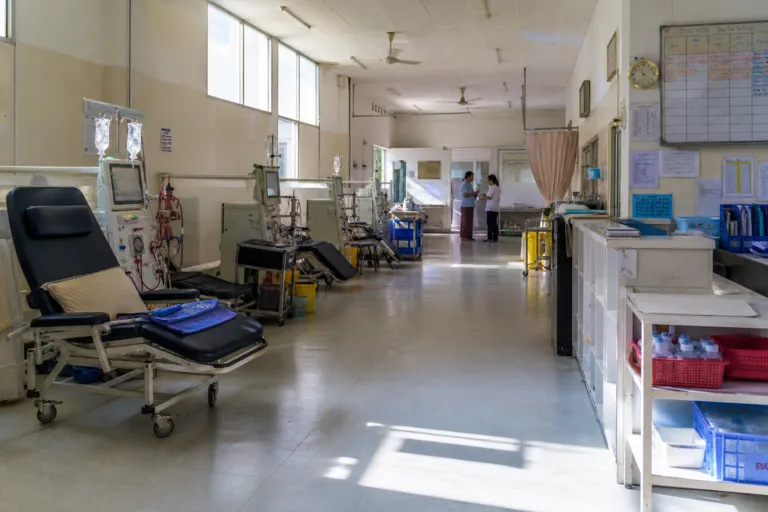
Myanmar’s dialysis center expansion conversation in 2026 is unfolding inside a global upswing in kidney replacement therapy demand. The Business Research Company estimates the global kidney dialysis market at $90.88 billion in 2025 and projects $97.98 billion in 2026, with a forecast of $134.49 billion by 2030 at an 8.2% CAGR. That same source frames growth around chronic kidney disease and expanding dialysis centers and hospitals. These global signals do not quantify Myanmar demand directly, but they do set expectations: rising patient volumes tend to translate into recurring needs for machines, consumables, dialysis drugs, and services across both hospitals and dedicated dialysis centers.
Across 2026–2035, other forecasts reinforce that the overall market expansion is steady rather than short-lived. Global Market Insights values the global dialysis market at USD 99.5 billion in 2025 and expects a 5.5% CAGR from 2026 to 2035, adding that the forecast depends on whether clinical need is matched by reimbursement coverage, trained workforce capacity, home-care infrastructure, and reliable consumable supply. Those conditions matter for Myanmar’s renal care planning because they convert “demand” into delivered treatments. Put simply, dialysis capacity is not only about adding chairs or shifts; it also depends on staffing, logistics, and continuity of supplies that keep patients on schedule.
What 2026 Demand Signals Mean for Center Build-Out Choices
Several sources highlight modality mix and care setting as key strategic variables. Precedence Research estimates the global dialysis market at USD 128.36 billion in 2026 and notes that services represent the largest share (79%), while hemodialysis holds a 56% share in 2026. That breakdown suggests that, operationally, care delivery capacity and staffing models can be as decisive as device procurement. For Myanmar dialysis and renal care market stakeholders, this implies that expanding treatment slots may require parallel investment in service delivery systems, including patient scheduling, infection control, and consistent clinical oversight—especially as demand rises with chronic disease pressure.
Equipment trends add another layer to 2026 expansion decisions. Global Market Insights estimates the global dialysis machines market at USD 4.8 billion in 2025, rising from USD 4.2 billion in 2022 and USD 4.6 billion in 2024; it forecasts USD 4.9 billion in 2026 and USD 7.7 billion by 2035 at a 5.1% CAGR. The same report shows how policy and infrastructure shape modality adoption: peritoneal dialysis (PD) represented 47.1% of dialysis patients in Hong Kong under a PD-first approach, while 18.2% of Canadian prevalent dialysis patients used PD in 2024. These comparisons are not Myanmar data, but they illustrate that PD uptake is tied to training, consumable logistics, and remote clinical oversight—not just clinical need—so Myanmar planning must align modality goals with system readiness.
Technology direction also points to where capacity could grow beyond traditional in-center models. Emergen Research values the global dialysis market at $114 billion in 2025 and projects $180 billion by 2035 at a 4.68% CAGR, while describing rising adoption of wearable and portable dialysis devices as a factor expected to reshape care delivery models between 2026 and 2027. Meanwhile, The Business Research Company lists home care alongside dialysis centers and hospitals as end users. For Myanmar’s 2026 kidney-care expansion agenda, the practical takeaway is sequencing: build reliable center throughput first, then extend access via home-capable pathways where training, monitoring, and supply chains can support safe treatment continuity.
What do global forecasts imply for Myanmar’s dialysis center expansion in 2026?
Which dialysis segment appears most dominant in 2026 market mix?
What conditions can limit dialysis growth even when clinical need rises?
What do PD adoption examples in other systems show for Myanmar renal care planning?
How is the Myanmar dialysis and renal care market being shaped by global technology trends?