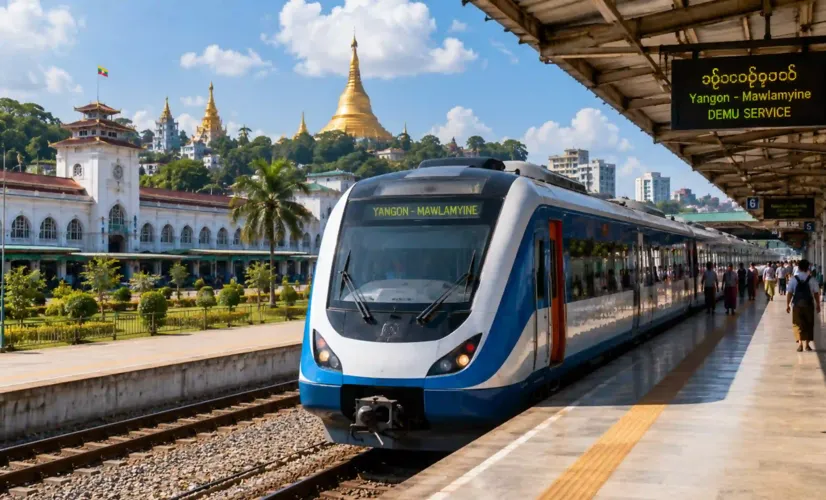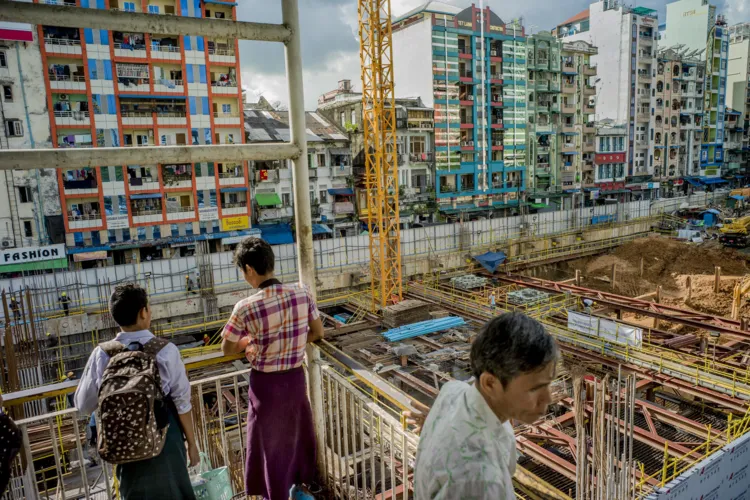
Large parts of Myanmar continue to experience daily power outages linked to fuel shortages, damaged infrastructure, and conflict-related disruption, according to Mizzima’s reporting on the junta’s energy self-sufficiency push. The same report says energy security and electricity supply are now placed at the centre of economic strategy, framed as essential for national economic development. For households and businesses, the result is dependence on ad hoc solutions rather than stable, nationwide service. This context sets the baseline for a grounded Myanmar electricity market analysis: reliability is constrained by supply-side stress and by conditions that make system-wide repairs and fuel sourcing difficult.
Structural limits predate the current crisis. Wikipedia’s overview says electrification was 50% in 2019, and estimates that 65% of the population lacked access to the national grid as of 2019. It also notes that as of 2023, only 73.7% of the population had access to at least 4 hours of electricity per day. The same source describes heavy reliance on biomass in rural areas, stating that 65% of total primary energy supply consisted of biomass energy and that it was used almost exclusively in the residential sector (97%). These figures underline why outages and uneven supply quickly translate into economic and social friction.
Energy Mix Shifts, Gas Constraints, and Why Solar Is Rising
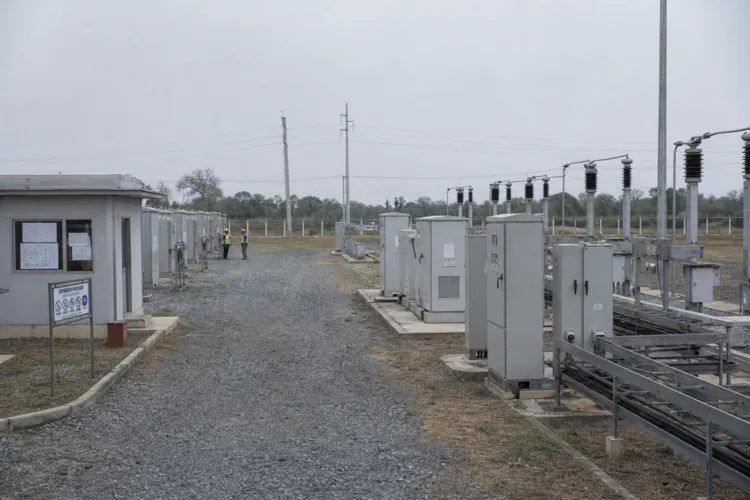
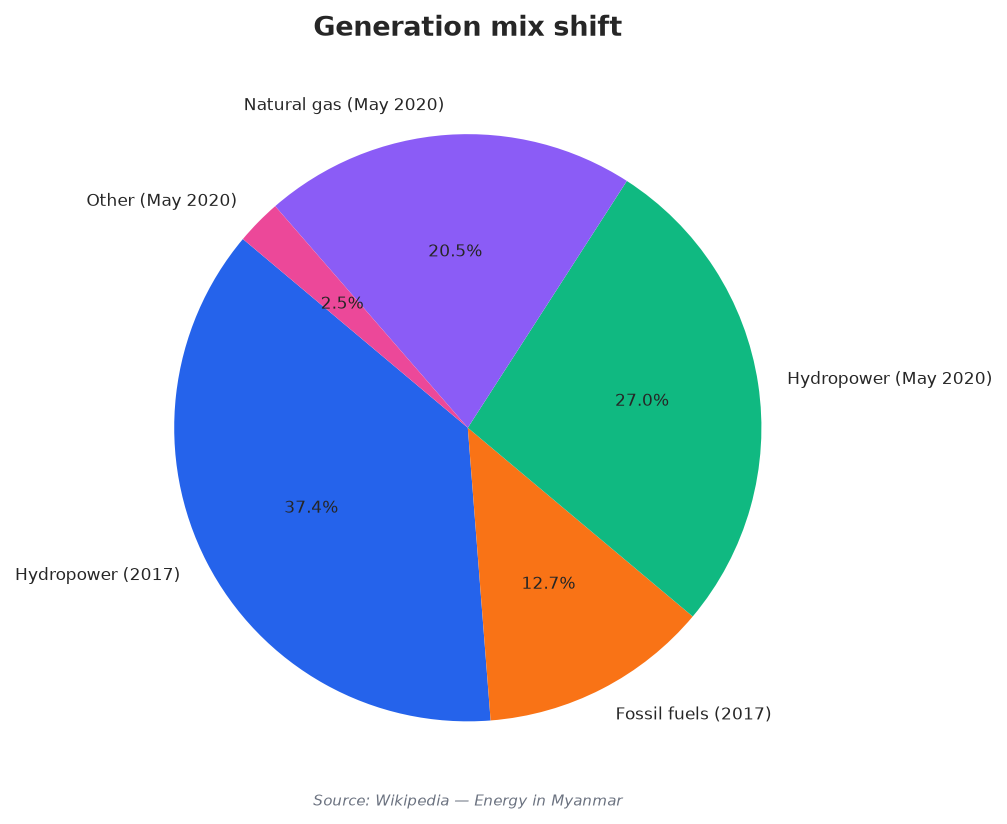
Myanmar’s power mix has been shifting over time. Wikipedia reports that in 2017 electricity production was dominated by hydropower at 74.7% of total generation, but by 2020 hydro’s share had fallen to 54% as natural gas grew to 40%. It also states that in May 2020 total installed capacity was 6034 MW, including 3262 MW of hydropower (54%) and 2496 MW of natural gas (41%). Reuters adds an operational constraint: it cites a World Bank June 2024 report saying the drop was largely due to a shortage of natural gas, Myanmar’s main generation fuel, as domestic production has declined and the government has halted imports of liquefied natural gas due to a foreign exchange shortage.
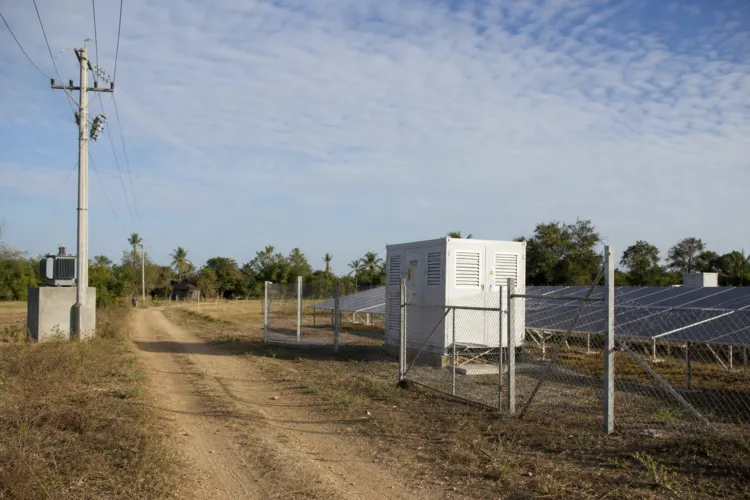
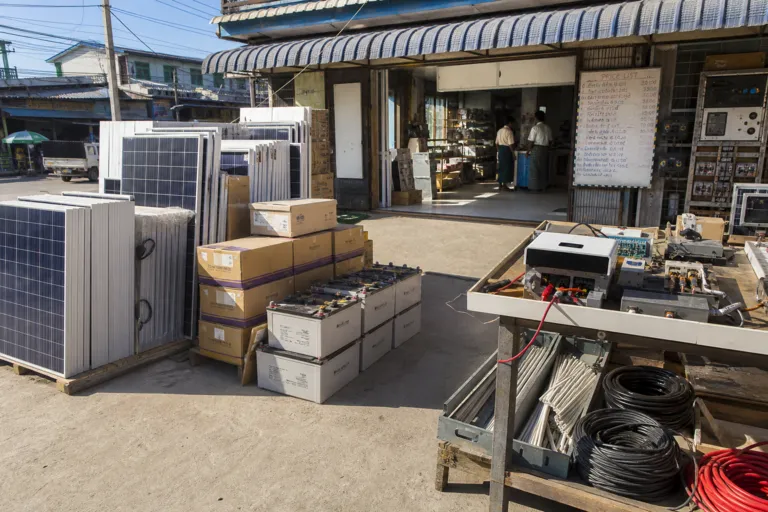
Against this backdrop, small-scale solar is increasingly used as a reliability tool. Reuters reports that shops, restaurants, and workshops seeking dependable power for lighting, refrigeration, and electronic payments, as well as water kiosks, clinics, and schools, are increasingly using small solar systems. It also quotes an example from Mawlamyine where an ice cream seller relied on solar because “the electricity here is not regular.” Most notably, Reuters states that household solar installations surged from a few hundred in 2019 to roughly 300,000 in 2025, as users switched from diesel generators to solar panels with storage. The same Reuters report frames Myanmar’s solar momentum as driven by energy security concerns and fuel shortages.
The policy narrative is increasingly centred on self-sufficiency, but delivery remains hard. Mizzima says the junta is prioritizing domestic production and electricity generation to address chronic blackouts and fuel shortages amid ongoing conflict and economic turmoil, while also noting that ongoing instability continues to cripple the power sector. Wikipedia documents longer-term targets set by the government, including an aim for 100% electrification by 2030 and a plan to increase the share of renewable energy to 12% by 2025. For market watchers, the near-term story is a tension between official objectives and the on-the-ground reality of outages, fuel constraints, and decentralised coping strategies that are already reshaping demand for solar and storage.
What is driving Myanmar’s current power shortage?
How has Myanmar’s electricity generation mix changed?
How fast are household solar installations growing in Myanmar?
What does a Myanmar electricity market analysis need to focus on right now?