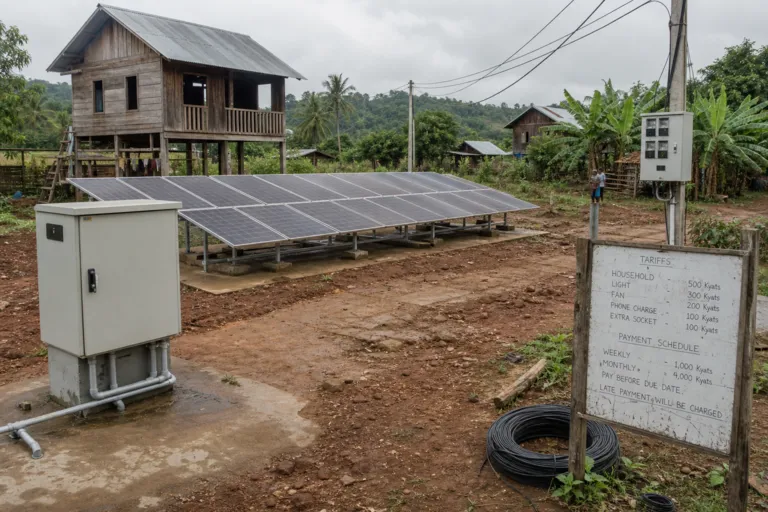
Rural electrification demand in Myanmar is being pulled in two directions in 2026. On one side, electricity supply and affordability pressures are pushing households, communities, and businesses to look for alternatives that can work without dependable grid service. On the other side, the ability to pay and the ability to finance systems are not moving as fast as demand. The World Bank’s rooftop off-grid solar assessment, summarized by REGlobal, frames this clearly: solar is now the most cost-effective electrification option for a growing share of Myanmar’s energy demand. That shift is not abstract. It shows up in fuel prices, tariffs, and project economics that are changing buying decisions across rural areas and in towns that still face reliability issues.
The strongest near-term demand driver is the jump in the cost of conventional energy. Monthly average diesel prices rose by nearly 900% in nominal terms, from MMK 682 per liter in January 2021 to MMK 6,057 per liter in April 2026. Grid costs also moved. Industrial grid tariffs increased by 80% in February 2026. Against that backdrop, REGlobal reports that the cost of energy from large commercial and industrial solar-plus-battery systems is US$0.205 per kWh, cheaper than the industrial grid tariff of US$0.250 per kWh. These comparisons matter for investment decisions because they compress payback expectations and make self-supply solutions feel less like a luxury purchase and more like operating-cost management.
What 2026 Signals Say About Mini-Grid and Solar Home System Demand
Demand signals are also visible in market activity and product positioning. The World Bank summary cited by REGlobal says the commercial and industrial segment is approaching commercial viability and likely to keep growing largely on commercial terms. It estimates that approximately 110 to 170 new C&I projects are delivered every year, and that payback periods have shortened to one to three years. It also identifies at least seven commercial power purchase agreement projects to date. In parallel, an inverter-market review that covers Myanmar, including off-grid rural areas, describes a power crisis where grid electricity is often available for only a few hours per day. It also claims off-grid low frequency inverters are “critical” for the 58% of the rural population without electricity. Together, these points imply continued pull for both mini-grid style systems and solar home system-type solutions that depend on robust off-grid power electronics.
However, high willingness to adopt does not automatically translate into widespread installations in rural and public-service settings. REGlobal’s summary highlights that community facilities remain structurally excluded from the prevailing market. Among health facilities surveyed, 57% of rural health centers lack reliable electricity, and 83% of facilities without solar cite high up-front cost as the principal barrier. Yet the same survey results show exceptionally strong latent demand: 98% of surveyed facilities would endorse a solar installation. For service design, 87% to 89% of hospitals and rural health centers express moderate to high interest in service-based delivery models. This is why the report recommends shifting from up-front capital subsidies toward an energy service delivery model, pairing milestone-based CAPEX subsidies with tariff-backed performance guarantees and a dedicated guarantee mechanism to protect energy service company revenue.
For 2026 planning, the constraint is less about whether the Myanmar off-grid solar market has demand and more about whether it has workable channels to convert that demand into financed systems. REGlobal’s summary states that the binding constraint on solar market growth is the absence of viable financing channels, not the absence of demand. It notes that liquidity exists in Myanmar’s financial system but is not deployed in solar, and that commercial banks mandate collateral requirements of 100% to 200% of loan value, while lacking technical frameworks to assess solar-specific risk. For rural mini-grids and solar home systems, these specifics point toward delivery models that reduce up-front cost exposure and create bankable performance assurance, rather than relying only on one-time equipment sales.
What is driving off-grid solar demand in Myanmar in 2026?
How does solar-plus-battery compare with industrial grid tariffs in 2026?
What does the World Bank summary say about project momentum in the commercial and industrial segment?
What barriers limit solar adoption in rural health facilities?
What is the main challenge holding back the Myanmar off-grid solar market, according to the World Bank summary?