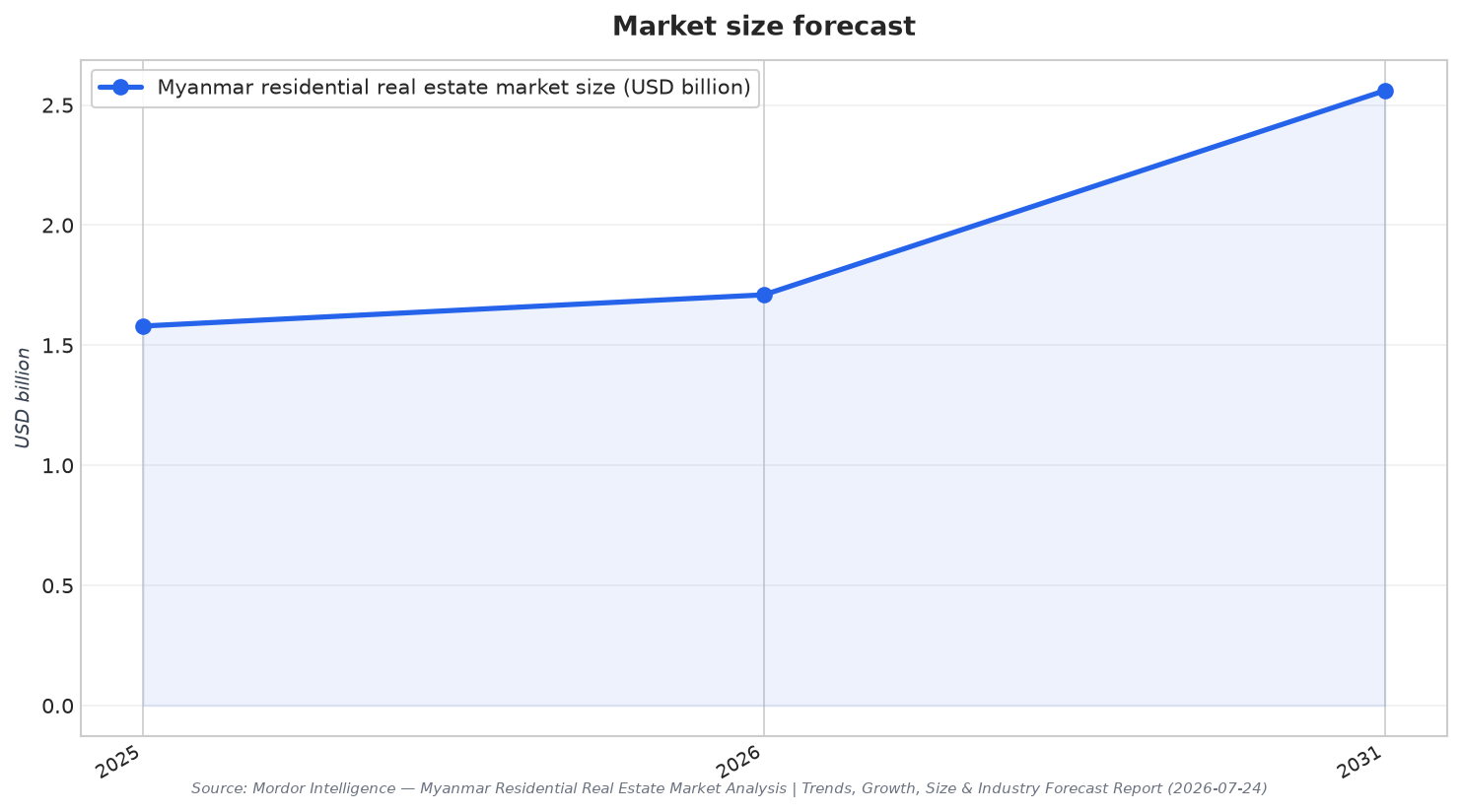
Yangon enters 2026 as the biggest revenue engine in Myanmar’s residential market, with a 48.65% city revenue share in 2025 (Mordor Intelligence). At the national level, Myanmar’s residential real estate market size in 2026 is estimated at USD 1.71 billion, up from USD 1.58 billion in 2025, with projections reaching USD 2.56 billion by 2031 at an 8.35% CAGR for 2026–2031 (Mordor Intelligence). That wider context matters for Yangon because the same report links demand to urbanization in Yangon and Mandalay, plus returning diaspora capital and large-scale infrastructure projects. At the same time, it flags inflation, currency volatility, and scant mortgage financing as constraints on household purchasing power.
Price direction is not one straight line, and recent history shows why. Yangon residential prices rose 4–6% throughout 2024, then shifted to flat or slightly declining trends in 2025 (Bamboo Routes, Sep 2025). That same 2025 snapshot puts standard apartments at an average of K90 million, while condominiums eligible for foreign ownership are cited around K267.5 million for an 80 square meter unit (Bamboo Routes, Sep 2025). Moving into 2026, one Yangon-focused forecast expects residential prices to grow around 15% to 25% in MMK terms over the full calendar year, with apartments likely to lead and high-end properties lagging (Bamboo Routes, Jan 2026). Another nationwide view says property prices in 2026 are rising in nominal kyat terms, especially in Yangon, while cautioning that inflation explains a large part of that movement (Bamboo Routes, Jan 2026).
What Will Move Yangon in 2026: Demand Mix, Product Types, and Location
Across Myanmar, the structure of demand helps explain why Yangon’s mid-market and apartment stock keeps coming up in 2026 narratives. Condominiums held 66.45% of Myanmar’s residential market size in 2025 and are expanding at a 9.38% CAGR through 2031 (Mordor Intelligence). Affordable housing commanded a 51.85% share in 2025, while mid-market housing is projected to grow at a 9.21% CAGR through 2031 (Mordor Intelligence). Transaction channels also matter: primary transactions represented 71.05% of the market in 2025, while secondary resales are climbing at a 9.28% CAGR to 2031 (Mordor Intelligence). For Yangon specifically, Bamboo Routes identifies townships with fast-rising nominal pricing signals in 2026, including Sanchaung (around 35% to 45%), Kamaryut (around 30% to 40%), and Hlaing (around 28% to 38%) in kyat terms.
Risk framing is as important as upside framing, especially for buyers benchmarking kyat prices to USD. Bamboo Routes estimates that as of early 2026, the likelihood of a meaningful price drop is “medium,” with around a 35% chance of a 10% or larger nominal decline in non-prime submarkets and closer to 20% in prime Yangon locations like Bahan or Kamayut (Bamboo Routes, Jan 2026). It also notes that Yangon asking prices rose by an estimated 10% or more in nominal terms over the past 12 months, but slower than roughly 23% to 30% inflation, implying real values likely declined (Bamboo Routes, Jan 2026). In parallel, Mordor Intelligence highlights constraints like inflation, currency volatility, and limited mortgage financing, even as it describes demand for secure, amenity-rich condominiums. For Myanmar real estate consulting work, these numbers argue for underwriting both nominal growth and inflation-adjusted outcomes.
For 2026 decision-making, it helps to pair macro shares with on-the-ground purchasing ranges. Bamboo Routes estimates an average house price in Myanmar of about MMK 370 million in 2026, roughly USD 176,000, and an average of about MMK 3.1 million per square meter, roughly USD 1,500 (using official Central Bank of Myanmar reference rates, per the source). It also gives a realistic purchase range of about MMK 120 million to MMK 900 million, roughly USD 57,000 to USD 429,000 (Bamboo Routes, Jan 2026). The same source estimates nominal property prices increased by about 39% over the past 12 months in kyat terms, with a realistic range of 25% to 60% depending on property type, and notes that ordinary apartments rose faster than large houses because they have a deeper buyer pool. Taken together with Yangon’s 2025 revenue lead and 2026 growth forecasts, the market outlook is less about a single direction and more about choosing the right segment and township under clearly stated risks.
What is the 2026 market size estimate for Myanmar residential real estate?
How much of Myanmar’s residential revenue did Yangon represent in 2025?
What is the 2026 price growth forecast for Yangon in kyat terms?
Which Yangon townships were cited as fast-rising areas in 2026?
How can Myanmar real estate consulting use the 2026 risk estimates for Yangon?