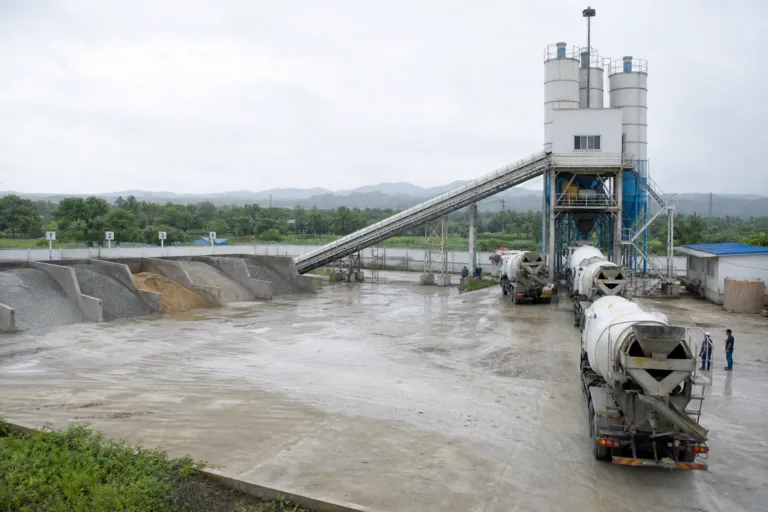
Reconstruction-linked building activity in 2026 will translate into demand for ready-mix concrete and aggregates, but Myanmar’s near-term capacity to serve pours is shaped by the concrete-mixer lorry market. IndexBox describes Myanmar’s concrete-mixer lorries segment as structurally import-dependent, with the overwhelming majority of units entering as used or new imports from Japan, South Korea, China, and Europe. Domestic activity is described as limited to body-mounting and refurbishment on imported chassis. That profile matters for reconstruction work because ready-mix throughput is not only about batching plants. It is also about trucks, lead times, and the cost and availability of fleets that can haul consistent volumes to sites.
In Myanmar, demand is concentrated in the Yangon, Mandalay, and Naypyidaw corridors where ready-mix suppliers, large contractors, and infrastructure projects operate, according to the same IndexBox report. Drum capacities of 6–10 cubic metres dominate, and 8 cbm is cited as the most common urban specification. This corridor focus implies that aggregate pull will also be strongest where fleet density and dispatching are most developed, while many provincial areas remain more tied to on-site mixing and smaller 6–7 cbm units. IndexBox also notes that ready-mix penetration is rising in Yangon and Mandalay, pulling demand toward larger drum capacities and GPS-enabled fleet management, which can raise effective utilization when reconstruction schedules get tight.
What Mixer-Lorry Economics Say About 2026 Supply
Fleet economics can either unlock or cap how fast ready-mix and aggregates demand converts into delivered volume. IndexBox reports that used Japanese and Korean mixer lorries typically range from USD 25,000 to USD 70,000 depending on age, drum size, and condition, while new Chinese and European units land at USD 80,000–180,000. It also states that import duties and taxes on commercial vehicles can add 20–50% to landed cost, depending on origin, engine size, and classification. For reconstruction contractors and suppliers, those ranges influence whether they stretch existing fleets, buy used units, or attempt new purchases—each path affecting how reliably aggregates and concrete can flow to job sites.
Replacement timing and financing are another constraint on delivered ready-mix capacity. IndexBox states replacement cycles average 7–12 years in Myanmar, longer than in developed markets, because operators repair rather than replace. That extends the installed base but suppresses new-unit demand, shifting more revenue toward spare parts and refurbishment services. The report also highlights downside risk from political instability, currency volatility, and financing constraints that keep 60–80% of purchases cash-based or short-term credit. It adds that foreign-exchange scarcity can make it difficult to secure letters of credit for vehicle imports, lengthening lead times and creating price uncertainty that discourages fleet expansion.
Global ready-mix benchmarks help frame the direction of travel without being Myanmar-specific. Multiple global sources forecast continued growth. Future Market Insights estimates the global ready-mix concrete market at USD 850.0 billion in 2026 and projects USD 1,450.0 billion by 2036, with a 5.5% CAGR from 2026 to 2036. The Business Research Company puts the global market at $992.8 billion in 2026, rising to $1,335.85 billion by 2030 at a 7.7% CAGR, and states Asia-Pacific was the largest and fastest growing region. Mordor Intelligence estimates global volume at 5.83 billion cubic meters in 2026, reaching 7.36 billion cubic meters by 2031. For the Myanmar ready-mix concrete market, the practical takeaway is that reconstruction demand will be judged on the ground by truck availability, after-sales coverage outside major cities, and the ability to import, finance, and keep mixer fleets running with reliable parts.
Where is Myanmar’s ready-mix demand most concentrated in 2026 planning?
What mixer drum sizes are most common for urban construction in Myanmar?
What price ranges are reported for mixer lorries imported into Myanmar?
How do import duties affect mixer-lorry landed costs in Myanmar?
What does the Myanmar ready-mix concrete market outlook depend on most in 2026 reconstruction?