Factory relocation conversations in 2026 increasingly link Myanmar to wider “China + 1” supply chain decisions. In Southeast Asia overall, manufacturing FDI reached USD 89 billion in 2024, up 42% from 2023, according to a Myanmar freight and logistics market analysis. The same source frames Myanmar as drawing a growing share of that movement. For decision-makers, this means the country’s attractiveness is often evaluated alongside execution realities like transport capacity, customs processes, and last-mile reliability. That is where Myanmar manufacturing consulting becomes practical: it translates a regional relocation thesis into plant location choices, freight routings, and compliance steps that match on-the-ground constraints.
FDI signals inside Myanmar are mixed and require careful reading by time period and source. Over the past decade, Myanmar has received more than USD 36 billion in FDI (January 2016 to December 2025), per ISP-Myanmar. Separately, GlobalData cites DICA data showing Myanmar secured MMK835.8 billion (USD 398 million) in foreign direct investment in the first 10 months of FY2025-26 (April 1, 2025, to March 31, 2026). GlobalData also describes this as a sharp decline from MMK656.2 million (USD 222.2 million) in the same period of FY2024-25, attributing weakness to geopolitical and internal political uncertainty during February and March 2026. For manufacturers, these figures reinforce the need to stress-test investment timelines against policy and operating volatility rather than assuming a smooth uplift.
Logistics Capacity Is Becoming the Core Relocation Question
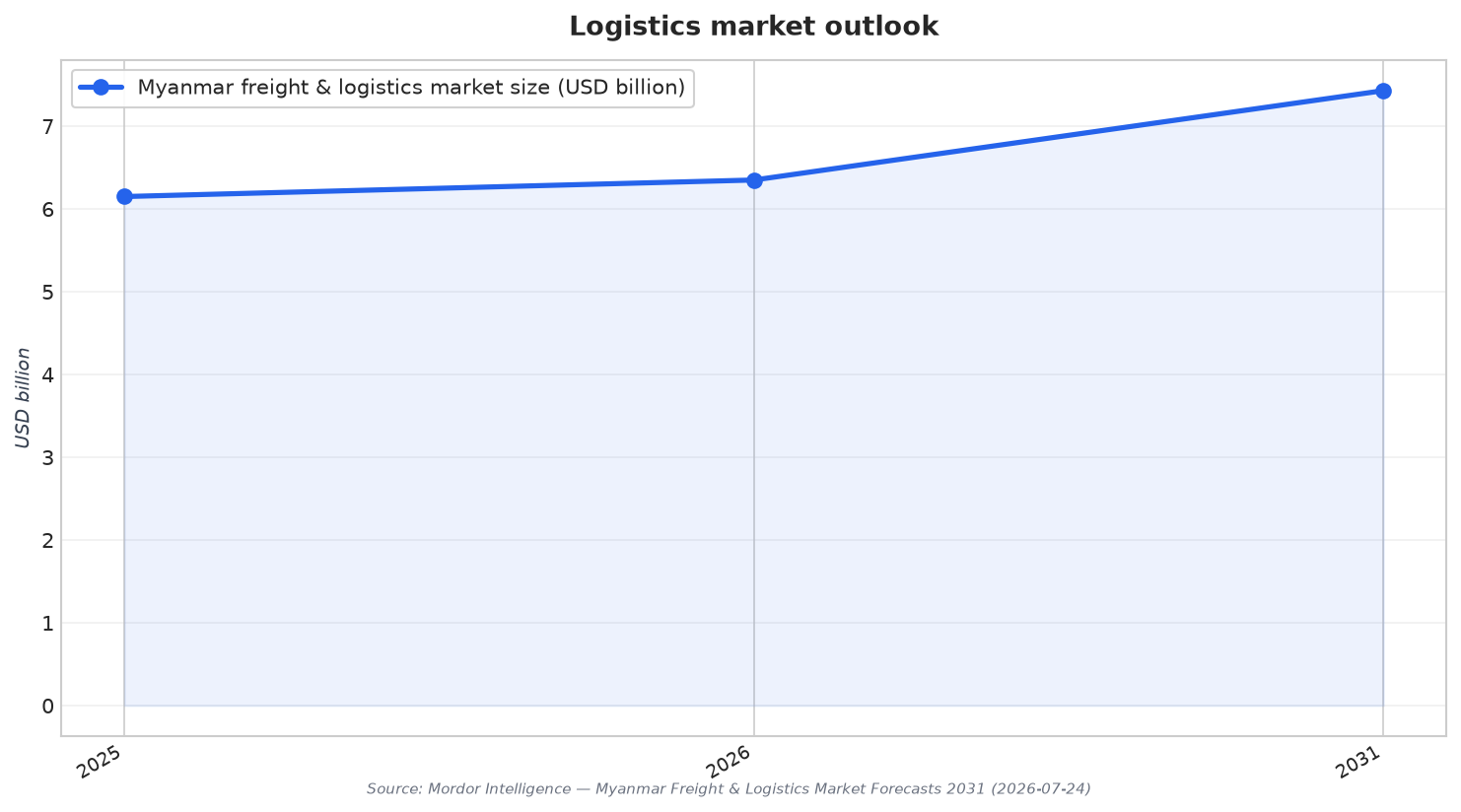
Execution depends on freight and warehousing capacity, and 2026 forecasts provide specific benchmarks for planning. Myanmar’s freight and logistics market is expected to increase from USD 6.15 billion in 2025 to USD 6.35 billion in 2026, reaching USD 7.43 billion by 2031, with a 3.21% CAGR over 2026–2031. In 2025, freight transport led with 60.15% market share, while sea and inland waterways represented 79.02% of freight forwarding revenue share. Road freight captured 71.12% of the freight transport segment revenue share in 2025. These mixes matter for relocation: they indicate where today’s capacity sits, and where constraints may appear when factories ramp exports or need reliable inbound components.
Several growth pockets can shape how investors design supply chains, especially for time-sensitive goods. Air freight forwarding is projected to register a 3.67% CAGR between 2026 and 2031, and air freight transport is expected to post a 4.12% CAGR over the same period. Courier, express, and parcel services are projected to expand at a 4.69% CAGR from 2026–2031, with international CEP forecast to grow at 4.88% CAGR. Warehousing remains dominated by non-temperature-controlled facilities, which held a 91.28% revenue share in 2025, while temperature-controlled capacity is expected to grow at a 3.07% CAGR during 2026–2031. For manufacturers considering relocation, these metrics support practical choices like whether to engineer around temperature control gaps or structure higher-value SKUs for faster air lanes.
Relocation feasibility also intersects with infrastructure and industrial buildout, and construction trends provide context. GlobalData projects Myanmar’s construction industry to decline marginally by 0.6% in real terms in 2026, while expecting 4.4% real-term growth during 2027 to 2030, supported by investments in manufacturing, transport, and renewable energy. Energy planning is presented as a driver: Myanmar’s National Electrification Master Plan aims to increase electricity production capacity from approximately 6,000MW in 2024 to 12,000MW by 2030, and the government is drafting a new 20-year energy development plan (2026–45). Taken together with the logistics outlook and stated risks such as political instability and foreign-exchange controls, investors can use a structured advisory approach to align site selection, utilities assumptions, and shipment designs with what the data actually implies for 2026 execution.
What does the 2026 logistics forecast imply for factory relocation planning in Myanmar?
What recent FDI figures are cited for Myanmar, and why do they matter for manufacturers?
How can Myanmar manufacturing consulting help investors in 2026?
Which logistics sub-sectors show faster growth signals after 2026?