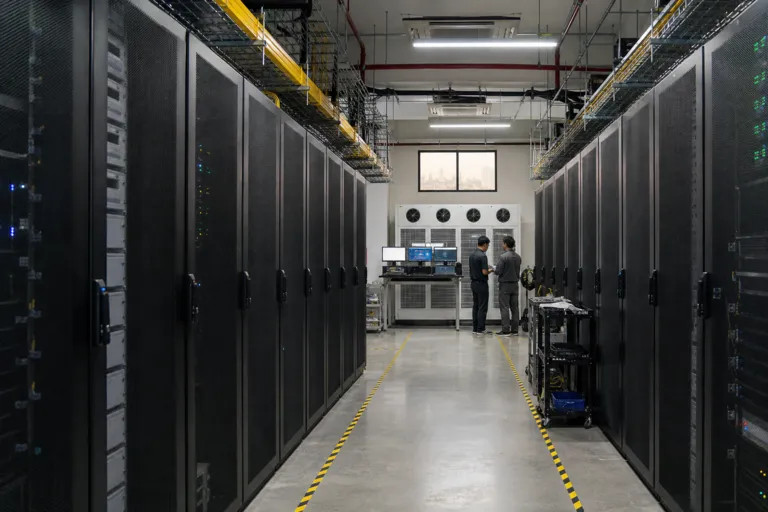
In 2026, Myanmar’s data center and cloud infrastructure demand sits at the intersection of policy, payments, and connectivity. Mordor Intelligence tracks an installed IT load of 1.5 MW in 2025 and projects the country’s data center capacity to reach 3.56 MW by 2030, advancing at an 18.87% CAGR over 2025–2030. The same report links demand to rising mobile internet penetration, rapid fintech adoption, and the government’s Digital Economy Roadmap 2025. For buyers, this translates into a practical requirement for secure, low-latency capacity that can serve enterprises and consumer-facing apps while meeting emerging local hosting expectations.
Fintech scale is one visible demand signal for resilient computing. KBZPay alone processes more than USD 9 billion annually, a figure that illustrates transaction volumes pushing investors toward highly resilient facilities. At the same time, data sovereignty is becoming structural to infrastructure planning. Under a 2025 Cybersecurity Law cited by Mordor Intelligence, mandatory data-sovereignty rules compel local hosting of e-government and critical financial datasets. The report also notes digital ID enrollment of 37 million citizens, which it ties to large storage requirements for biometric images and encryption keys. In parallel, ministries are piloting federated cloud sandboxes and AI-based public service chatbots, which increases compute density needs in Tier III rooms.
Where 2026 Demand Concentrates: Hotspots, End Users, and Edge Nodes
Location and buyer mix help explain how demand may concentrate through 2026. In 2024, Yangon led with 71% of the market share, while Mandalay is forecast to expand at a 17.80% CAGR through 2030, according to Mordor Intelligence. On the demand side, telecommunications companies accounted for a 26% share of the market size in 2024, and cloud service providers are projected to grow at a 19.60% CAGR from 2024 to 2030. Operators such as MPT and ATOM are connected to intensifying 5G rollouts, and the report describes denser edge-node requirements that favor colocation builds in Yangon and Mandalay as latency-sensitive use cases start moving closer to users.
Connectivity upgrades matter because cloud adoption rises when last-mile constraints ease. Mordor Intelligence reports peak download speeds of nearly 1 Gbps, which it says shorten last-mile bottlenecks and push operators to deploy micro-data centers for radio-access-network caching. In a separate ICT market source, GlobeNewswire reports that telecom operators have expanded prepaid distribution through more than 720,000 retail points, supporting higher mobile data consumption and the adoption of cloud platforms and digital payments. MarkWide Research adds a cautionary performance note, stating that fiber-optic backhaul capacity can limit last-mile throughput to approximately 100 Mbps in urban nodes, constraining cloud application performance for enterprise clients. These mixed realities keep edge capacity and network planning closely linked in 2026.
Even as local conditions shape build pace, global comparisons show why cloud and data center capacity planning remains urgent. Brightlio, citing Global Market Insights, reports that global data center supply across the 16 largest markets reached 16 GW in Q1 2026, up 25% year over year, while average vacancy fell from 8.3% to 6.7% as demand absorbed new capacity. For Myanmar, the same macro drivers—AI computing, hyperscale cloud expansion, edge infrastructure, and 5G—are repeatedly referenced across sources as demand tailwinds. Within the Myanmar data center market, the more actionable 2026 takeaway is operational: align colocation and cloud rollout with sovereignty requirements, payments-driven uptime needs, and hotspot economics centered on Yangon while tracking Mandalay’s faster forecast growth rate.
What capacity trajectory is projected for Myanmar’s data center sector through 2030?
Which city leads the market share, and what is Mandalay’s forecast growth rate?
How does fintech activity translate into infrastructure demand?
What does the 2025 Cybersecurity Law imply for hosting and cloud design?
What is the outlook for cloud service providers in the Myanmar data center market?