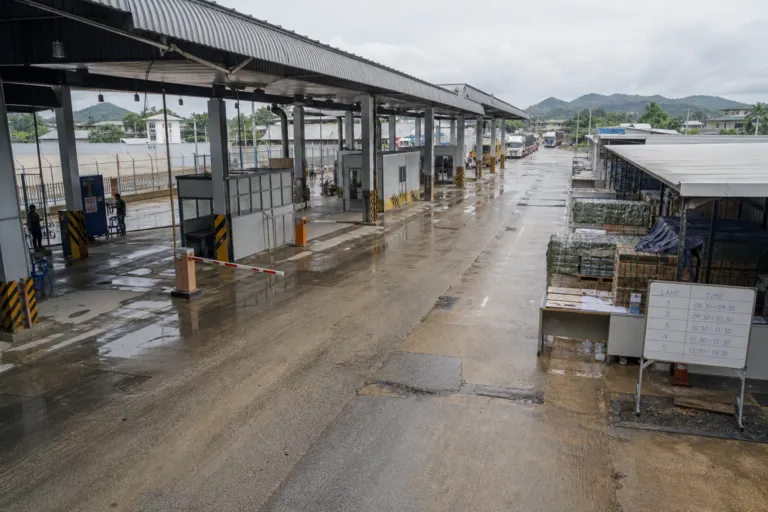
Border commerce between Thailand and Myanmar is built around a long land frontier of about 2,400 kilometers, with major gateways such as Mae Sot–Myawaddy, Tachileik–Mae Sai, and Ranong–Kawthaung. The Mae Sot–Myawaddy route is described as the most significant gateway and accounts for more than half of bilateral border trade, making it the key corridor to watch when disruptions occur. In 2026, trade conditions are framed by shifting geopolitics, fluctuating transport costs, and security issues, which can quickly translate into volatility at individual checkpoints and across border supply networks. These realities help explain why business expectations for 2026 balance recovery narratives with operational risk.
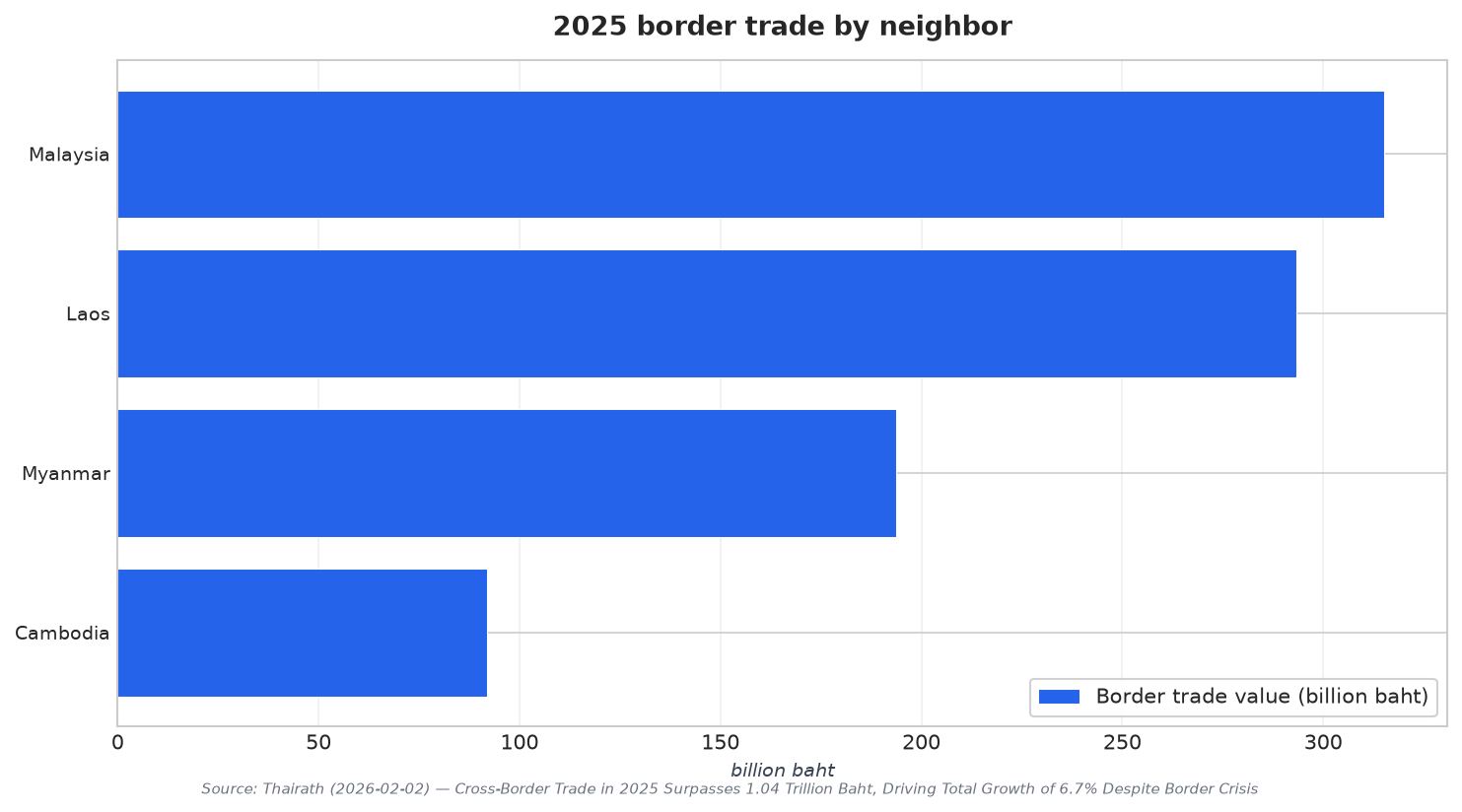
From Thailand’s perspective, official and media reporting sets a clear baseline for how large the system is and how it has been moving. In 2025, Thailand’s total border and cross-border trade value was 1,937.629 billion baht, expanding 6.7% year-on-year, with exports of 1,063.104 billion baht and imports of 874.525 billion baht, producing a surplus of 188.579 billion baht. Within that, cross-border (third-country) trade in 2025 totaled 1,043.436 billion baht, up 24.4%, with exports of 541.097 billion baht and imports of 502.339 billion baht, leaving a surplus of 38.757 billion baht. For 2026, Thailand’s Department of Foreign Trade set a target of 1.9 trillion baht for total border and transit trade, highlighting electronics as a key driver for transit growth amid ongoing uncertainty at some border points.
What Early 2026 Numbers Say About Recovery Momentum
Monthly reporting in 2026 shows a mixed picture: growth in the overall system, but weakness in some neighbor-specific border totals. In March 2026, Thailand’s border and cross-border trade totaled 178.32 billion baht, up 6.5% year-on-year. Exports were 93.26 billion baht (up 1.6%) and imports were 85.06 billion baht (up 12.4%), yielding an 8.2 billion baht surplus. For the first quarter of 2026, total value reached 478.9 billion baht, up 2.5%, with exports of 256.89 billion baht (up 0.4%) and imports of 222.01 billion baht (up 5.1%), generating a 34.88 billion baht surplus. The same March update also noted that cross-border trade continued to grow strongly, surging 41.4%, supported by significant expansion in electronics imports.
Recovery for Thailand–Myanmar flows is closely tied to Mae Sot–Myawaddy operations. The Second Thai–Myanmar Friendship Bridge (Myawaddy side opposite Mae Sot) had been temporarily closed since August 2025, and official statements in May 2026 linked the reopening decision to expectations of normalization and improved confidence as Myanmar’s new elected government signaled facilitation and regulatory easing. Even with that positive signal, March 2026 border trade with the four neighboring countries (Laos, Cambodia, Myanmar, and Malaysia) totaled 72.69 billion baht, down 21.6% year-on-year. In that breakdown, border trade with Myanmar was 17.09 billion baht, down 7.4%. This context shows why the narrative around Myanmar cross-border trade in 2026 is best described as recovery in progress rather than fully completed.
Longer-run context also matters, because border data can diverge from total merchandise trade that includes all channels beyond land checkpoints. Thailand’s merchandise exports to Myanmar were reported at US$4.17 billion in 2024, with top categories including mineral fuels and oils, beverages and spirits, vehicles, machinery and industrial equipment, and plastics and electric products. Meanwhile, border-trade-specific volatility remained visible in late 2025: one checkpoint recorded trade of 9,401 million baht in September 2025, a sharp year-on-year decline of about 40%, with disruptions such as bridge closures and regulatory tightening cited as contributors. For 2026 planning, these documented swings reinforce the importance of route resilience, compliance readiness, and close tracking of checkpoint status at the most trade-dominant corridors.
How is trade along the Thailand–Myanmar border defined in the sources?
Which crossing is described as the most important for Thailand–Myanmar border trade?
What do March 2026 figures show for Thailand’s border and cross-border trade?
What was Thailand’s recorded border trade value with Myanmar in March 2026?
What key event supported the recovery narrative for Myanmar cross-border trade in 2026?