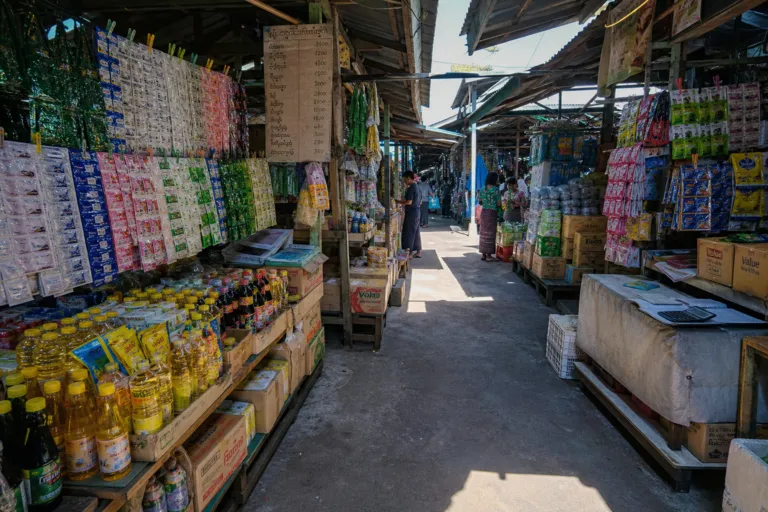
Consumer spending in Myanmar in 2026 sits under clear pressure from price dynamics. A 2026 economic overview notes that inflation remains a critical issue, with estimated inflation described as elevated compared to regional peers. It also states that price instability affects household purchasing power and consumer confidence. For day-to-day categories such as food, personal care, and household essentials, this kind of backdrop typically makes shoppers more cautious and value-focused, even when demand remains resilient. Any Myanmar consumer market analysis for 2026 should therefore start with the fundamentals of affordability, trust in pricing, and the ability of brands and retailers to hold availability when conditions are volatile.
FMCG planning for Myanmar can be anchored by documented global category drivers and constraints, while keeping the geographic scope explicit. A global FMCG market study forecasts expansion from $12,603.9 billion in 2021 to an estimated $19,718.5 billion by 2033, at a CAGR of 3.8%. The same source highlights growth drivers including growing urbanization with the growth of the middle class, growth in direct-to-consumer channels and e-commerce, and a rise in demand for hygiene and health products post-pandemic. It also flags restraints such as price sensitivity, intense competition, supply chain disruptions, and variable raw material costs. These global signals matter as context, not as a claim about Myanmar’s exact trajectory, but they map well to the pressure points Myanmar consumers face when purchasing power is strained.
What 2026 Signals for Myanmar FMCG Strategy
In 2026, the most practical FMCG playbook for Myanmar is to emphasize value, availability, and relevance, while staying realistic about consumer confidence. The global FMCG source lists trends that can guide brand choices: initiatives for eco-friendly and sustainable packaging, personalization and premiumization of daily goods, and localization of products and marketing strategies. For Myanmar, “localization” can be interpreted as tighter alignment to local tastes, pack sizes, and messaging that fits consumer constraints created by price instability. “Premiumization” may still exist, but it is likely to need sharper justification through visible quality cues or health and hygiene benefits, since price sensitivity is explicitly cited as a market restraint in the global analysis.
Digital and direct channels are also part of the 2026 story, again with careful scope. The global FMCG report points to growth in direct-to-consumer channels and e-commerce as a structural driver that has transformed purchasing behavior through convenience and broader selection. Translating that to Myanmar does not require assuming adoption rates; it simply means manufacturers and distributors can test channel mixes that reduce friction for repeat purchases and improve reach for essential items. The same report warns of supply chain disruptions and variable raw material costs, which can quickly feed into shelf prices. In a country where inflation is described as a critical issue, operational discipline around sourcing, pricing architecture, and pack strategy becomes central to protecting volume.
Category examples from Myanmar-specific product reports underline how uneven demand can be across consumer goods. An IndexBox report on Myanmar’s mobile phone market states that in 2025 the market decreased by X% to $X, ending a three-year rising trend, and notes consumption peaked at $X in 2017 and stayed lower from 2018 to 2025. Meanwhile, an oats market report states consumption saw an abrupt curtailment, with consumption peaking at $X in 2022 and failing to regain momentum from 2023 to 2025; it also says 2025 oat imports totaled X tons, remaining stable versus the prior year. These indicators do not quantify FMCG as a whole, but they reinforce the 2026 imperative: monitor category-level shifts closely, and avoid one-size-fits-all assumptions about Myanmar consumer spending.
What is the biggest factor shaping Myanmar consumer spending in 2026?
Which global FMCG trends are most relevant to planning for Myanmar in 2026?
What does the global FMCG forecast say about market growth through 2033?
How should a Myanmar consumer market analysis account for e-commerce and direct-to-consumer channels?
What do recent Myanmar product reports suggest about category-level volatility?