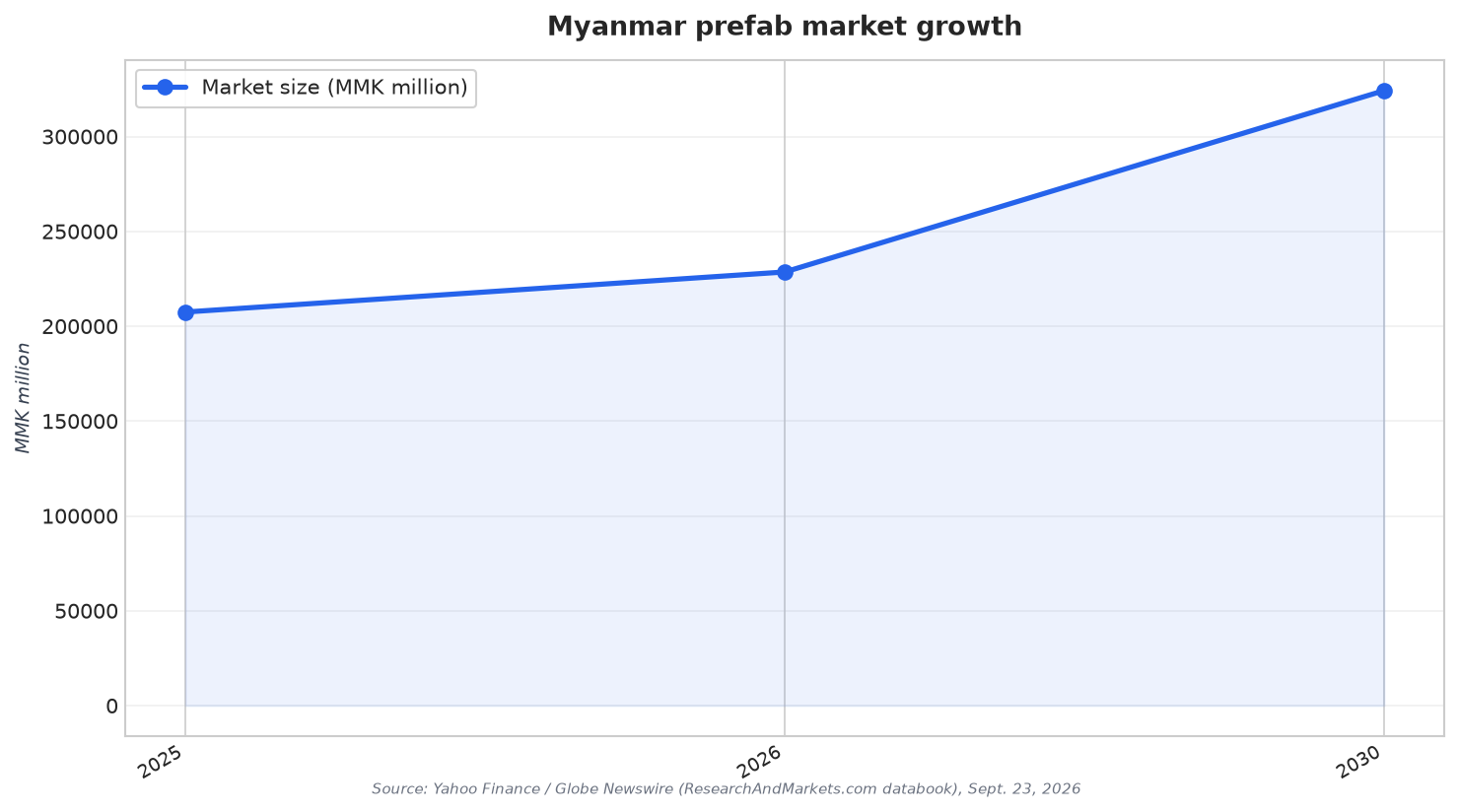
Modular and prefab adoption in Myanmar in 2026 sits at the intersection of market growth expectations and a challenging construction backdrop. A data-focused report update projects Myanmar’s prefabricated construction market will grow 10.2% on an annual basis to reach MMK 228,592.2 million in 2026. The same source notes the market achieved an 11.8% CAGR during 2021-2025, indicating that demand had already been building before 2026. In parallel, a separate construction outlook for the country projects Myanmar’s overall construction industry will decline marginally by 0.6% in real terms in 2026, citing ongoing political instability and rising geopolitical trade tensions. Taken together, these signals suggest prefab and modular approaches are being evaluated not only for growth, but also for predictability and delivery discipline in uncertain conditions.
For planning beyond 2026, the same Myanmar prefab databook forecasts continued expansion through the decade. It estimates a 9.1% CAGR for 2026-2030, taking the market from MMK 207,480.2 million in 2025 to approximately MMK 324,200.2 million by 2030. The report also positions this as actionable intelligence, emphasizing 100+ KPIs supported by charts and tables for country-level strategic planning, market entry, investment assessment, competitive benchmarking, and capacity development. For stakeholders, that matters because adoption decisions in modular and off-site construction often hinge on repeatable volumes, standardized design cycles, and measurable component demand rather than single-project wins.
What Adoption Looks Like: Methods, Products, Materials, and End Markets
Adoption in Myanmar is not described as one single “prefab” category. The Myanmar report segments the market by prefabrication method, covering panelized construction, modular (volumetric) construction, component-based prefabricated construction, and hybrid construction, with market share trend analysis spanning 2021-2030. It also breaks demand down by product categories such as building superstructures, roof systems, floor systems, interior room modules, exterior walls, columns and beams, and other prefabricated products. Material-level analysis includes iron and steel, concrete, wood, aluminum, glass, and other construction materials. For buyers and suppliers, these segment views help translate broad growth into practical choices, such as which product lines to prioritize and where substitution across materials may occur.
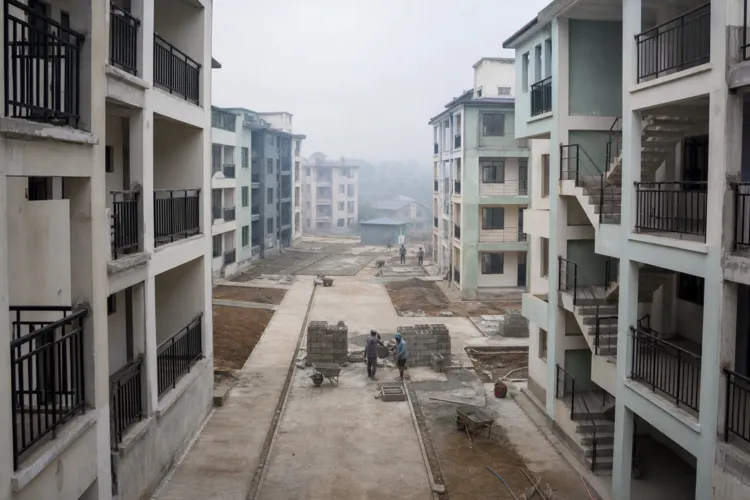
End-market adoption is also mapped in the country analysis across residential, commercial, industrial, and institutional construction. The residential segment is split into single-family and multifamily development, while commercial analysis covers office, retail, hospitality, and other applications. This segmentation is useful because modular uptake can differ sharply by client type and project constraints. For additional context, a South-Eastern Asia prefabricated buildings market report highlights that, in 2024, regional consumption volume was dominated by Indonesia, Vietnam, and the Philippines at 301K, 154K, and 130K units respectively, representing a combined 69% share of total volume. These figures are regional context, not Myanmar-specific, but they illustrate how adoption can scale when production and demand align.
In 2026, Myanmar’s construction environment adds practical considerations to adoption timing. GlobalData links the country’s 2026 construction outlook to political instability and geopolitical trade tensions, and it also reports Myanmar secured MMK835.8 billion ($398 million) in foreign direct investment in the first 10 months of FY2025-26, compared with MMK656.2 million ($222.2 million) in the same period of FY2024-25. Separately, a global report on multifamily modular and prefabricated housing warns that trade tariffs on building materials including steel and lumber can increase construction costs, and that trade barriers may affect availability and cost of imported components and prefabricated modules. For the Myanmar prefabricated construction market, these signals reinforce why local supply resilience, product standardization, and material strategy are central to modular and prefab adoption in 2026.
What is the 2026 growth outlook for Myanmar’s prefabricated construction sector?
What is the forecast for Myanmar’s prefab market through 2030?
Which construction methods are tracked in Myanmar’s prefabrication analysis?
How does the broader construction outlook in Myanmar compare in 2026?
What should stakeholders watch in the Myanmar prefabricated construction market in 2026?