In 2026, Myanmar’s private healthcare setup is described as a bridge rather than a destination for complex care. A stated protocol for serious cases is to stabilize patients at local facilities and then evacuate to Thailand for anything more complex. That referral reality matters for private hospital investment because it shifts the business case toward stabilization capacity, triage, referral coordination, and resilient operations rather than assuming full-spectrum tertiary care can be delivered everywhere. The same 2026 source stresses that a hospital is not just a building; it also has to act as a technology hub and a referral center, often serving as a last line of defense for populations with few alternatives.
Operational fit is repeatedly highlighted as a make-or-break factor in Myanmar. A context-aware design approach is recommended, because a hospital that ignores local realities such as flooding, disease seasonality, and unstable power will fail regardless of equipment quality. This pushes investors toward practical infrastructure choices that support continuity of care and reliable stabilization, supported by data for needs analysis and decision-making. In parallel, priorities cited for 2025 and 2026 include increased access to quality health services through mobile clinics, static health facilities, and teleconsultation, with a strong focus on sexual and reproductive health services, inclusion of people with disabilities, and strengthening access to data for informed planning.
What the Available Capacity Data Says—and What It Doesn’t
For baseline scale, CEIC reports Myanmar’s number of hospitals at 1,177 units in 2021, up from 1,168 units in 2020, with a recorded low of 1,151 units in 2019. That is total hospital count reporting, and it does not separate public from private facilities. On activity levels, CEIC reports inpatient activity at 2,747.000 person-thousand in 2017, increasing from 2,545.000 person-thousand in 2016. For outpatient activity, CEIC reports 10,190.000 person-thousand in 2017, up from 9,280.000 person-thousand in 2016. These indicators help frame utilization pressures, but they are not direct measures of private-sector bed capacity.
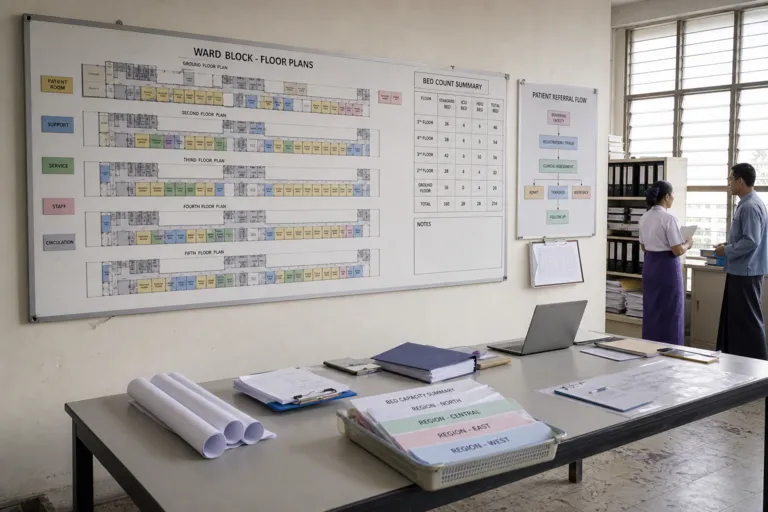
For beds, a specific scheduled hospital bed series is available for Nay Pyi Taw. CEIC reports Myanmar’s number of scheduled hospital beds in Nay Pyi Taw at 2,050 units in September 2021, unchanged from September 2020, with the same 2,050 level listed across the available 2019–2021 observations. This is a localized capacity datapoint and should not be generalized as a national figure. Still, it offers a concrete reference for planning discussions that need at least one verified bed-capacity anchor. Investors tracking the Myanmar hospital market can use this kind of city-level series to test whether new builds, expansions, or partnerships are targeting genuine gaps versus duplicating capacity.
Investment readiness in private care also links to equipment access and regulatory throughput. A June 21, 2026 snapshot of the Myanmar FDA medical device registry reports 6,068 active medical product records, covering 4,404 unique product generic names, involving 286 unique local importer companies holding active registrations. Another 2026 source describes public healthcare infrastructure as severely limited, with approximately 1,000 public hospitals that are concentrated in Yangon and Mandalay, and notes growth in private hospitals and clinics in Yangon sourcing quality equipment, alongside procurement by WHO, MSF, ICRC, and UN agencies. For comparison context on equipment categories rather than Myanmar totals, a global hospital bed market report values the hospital bed market at USD 5.2 billion in 2026 and projects USD 8.5 billion by 2033, with a 7.27% CAGR from 2026–2033; those figures are global and should not be read as Myanmar-specific.
In 2026, how does Myanmar handle serious cases in private facilities?
How many hospitals were reported in Myanmar in 2021?
What is a verified bed-capacity datapoint investors can reference for 2026 planning?
What does recent utilization data show for inpatient and outpatient activity?
What signals matter most when assessing the Myanmar hospital market in 2026?