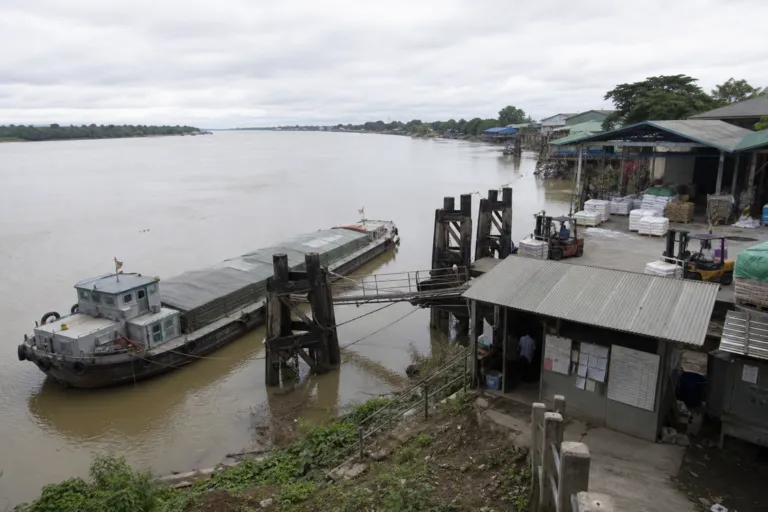
Irrawaddy (Ayeyarwady) river freight and barge logistics in 2026 must be understood in the context of Myanmar’s wider freight and logistics sector. Mordor Intelligence estimates the Myanmar freight and logistics market rising from USD 6.15 billion in 2025 to USD 6.35 billion in 2026, with a projection of USD 7.43 billion by 2031 and a 3.21% CAGR over 2026–2031. Within that system, forwarding revenue is heavily tied to maritime-linked flows: sea and inland waterways together accounted for 79.02% of freight forwarding revenue share in 2025 (Mordor). For Irrawaddy operators, this framing matters because river moves often depend on how cargo is consolidated for Yangon-area gateways and how documentation and visibility are handled across a multimodal chain.
At the same time, river services compete against a domestic network where road remains the default. MarkWide Research describes domestic tonnage as road-dominated, citing limited rail gauge compatibility and underdeveloped inland waterway integration. Mordor’s breakdown aligns with that competitive reality: road freight transport captured 71.12% of freight transport segment revenue share in 2025. This does not eliminate the role of barges on the Irrawaddy, but it means barge operators often win when shippers prioritize bulk, non-urgent cargo, or when river legs reduce exposure to diesel price volatility that MarkWide flags as a margin pressure for road carriers. In practice, barge logistics planning in 2026 has to be tightly synchronized with trucking capacity for first-mile pickup and final delivery.
Operational Risks and Cost Pressures on the Ayeyarwady in 2026
Regional inland-waterway conditions also shape what is possible on Myanmar’s main river. In an ASEAN inland waterway transport report, Mordor notes that the Mekong and Ayeyarwady rivers handle up to 30 million tons of rice, maize, and fruit each year, while severe 2024 droughts pushed salt intrusion 90 kilometers inland and stopped barge traffic during a critical spring harvest period. The same source adds that Myanmar’s Ayeyarwady remains vulnerable to political instability, with carriers negotiating ad-hoc passage fees that can raise freight costs by as much as 20%. These are not abstract risks for 2026 contracts: they influence buffer time, contingency routing, and how shippers price reliability versus cost when committing volumes to barges.
On the demand side, logistics revenue pools in Myanmar are shifting in ways that can support better-structured river offerings, especially when paired with warehousing and compliance services. Ken Research reports merchandise trade at approximately USD 30.12 Bn during April 2023 to February 2024, sustaining demand for cargo handling and storage. It also reports approximately 783,000 TEU of container throughput in 2024, with Yangon-area ports handling the majority of maritime imports and exports. MarkWide adds that customs modernization and cross-border corridor activation are restructuring the sector, including digitization protocols from the Directorate of Trade and the ASEAN Single Window initiative shaping documentation standards. For Irrawaddy logistics, the commercial opportunity is often in bundling: predictable barge schedules linked to bonded warehousing near Yangon and clearer documentation handoffs for onward movement.
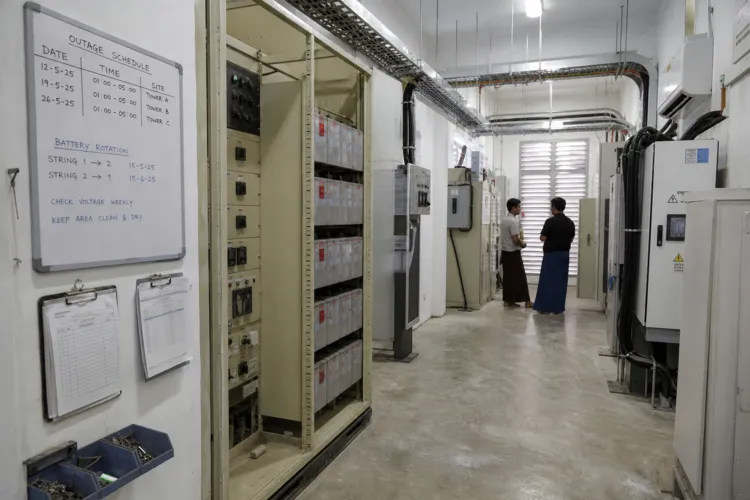
Technology and service expectations are also tightening the barge-and-river value proposition in 2026. MarkWide highlights Track & Trace technology as a leading investment priority as shippers demand real-time visibility, while it describes automated warehousing as the fastest-growing technology segment but constrained by electricity reliability outside Yangon and Mandalay. Ken Research similarly emphasizes that yields are expected to favor operators with secured compounds, backup generation, and digital tracking. For the Myanmar inland water transport market, this points to a practical 2026 playbook: treat barges as part of an integrated corridor product, price for disruption risk explicitly, and compete on documentation readiness and shipment visibility rather than assuming that river freight’s historic cost advantage will sell itself.
What is the 2026 outlook for Myanmar’s freight and logistics market size?
How important are sea and inland waterways in freight forwarding revenue?
What cost risks affect barge logistics on the Ayeyarwady?
What evidence shows disruption risk on major river corridors in the region?
How should shippers think about the Myanmar inland water transport market in 2026?