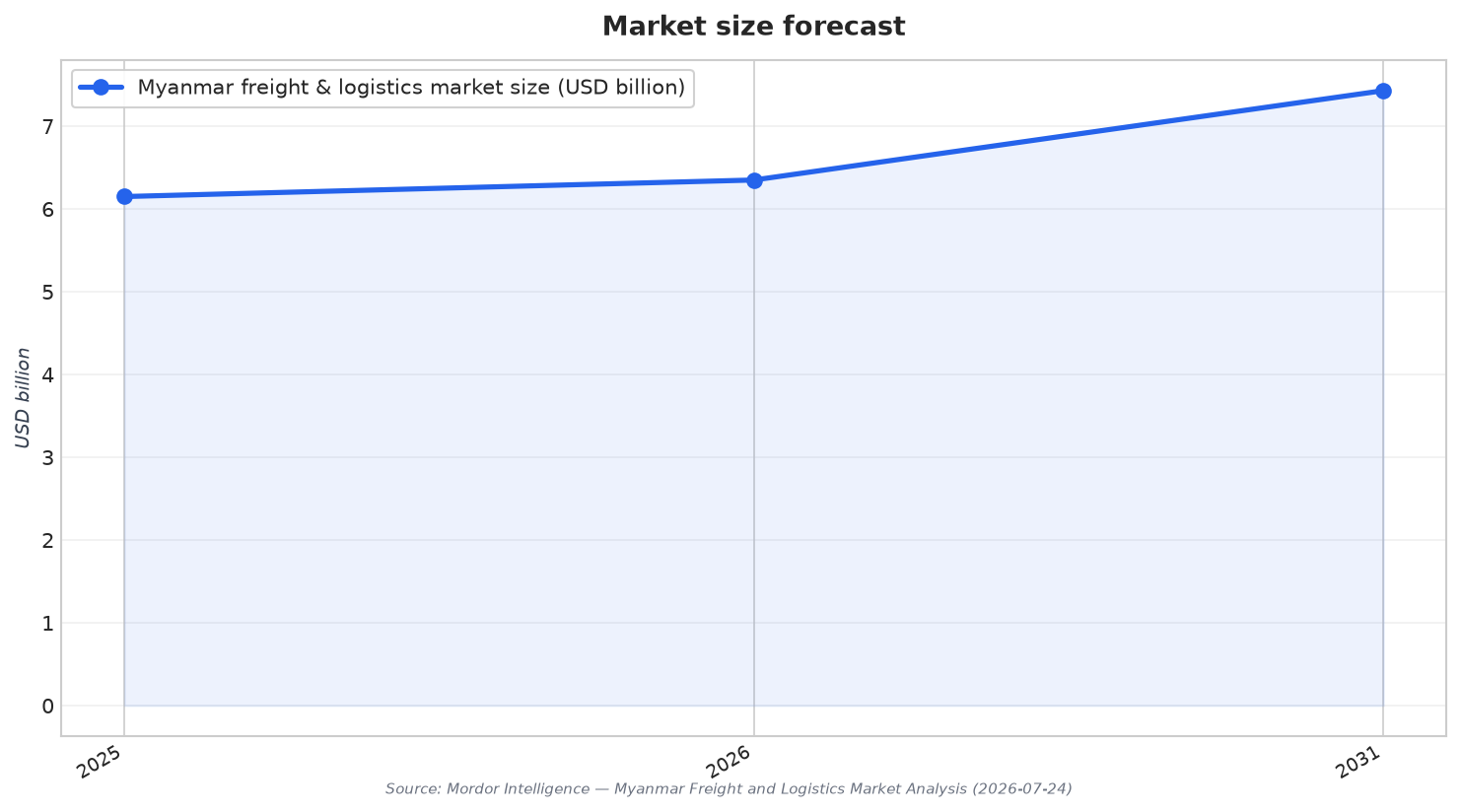
Freight forwarding and customs clearance services in Myanmar in 2026 sit inside a logistics market that multiple sources forecast to expand steadily. Mordor Intelligence expects the Myanmar freight and logistics market to rise from USD 6.15 billion in 2025 to USD 6.35 billion in 2026, and to reach USD 7.43 billion by 2031, reflecting 3.21% CAGR over 2026–2031. Ken Research also frames the market at USD 6,150 million in 2025 and projects USD 7,430 million by 2031 with a 3.2% forecast CAGR, describing fragmented road freight networks, port-linked forwarding, customs brokerage, and contract warehousing. In practice, this means forwarders compete by combining transport execution with documentation, visibility, and compliant storage that reduces disruption risk.
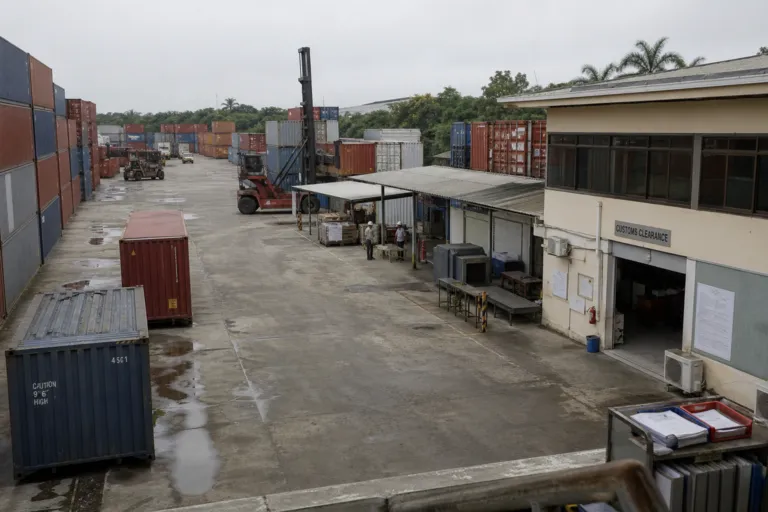
Gateway concentration matters for service design and pricing. Ken Research notes that Yangon and the adjoining Thilawa industrial-port area form the dominant national logistics gateway, and Myanmar recorded approximately 783,000 TEU of container throughput in 2024, with Yangon-area ports handling the majority of maritime imports and exports. MarkWide Research reinforces the idea of port-linked leverage by noting that A.P. Moller – Maersk leverages terminal operations at Yangon Port to control container throughput capacity, while other operators anchor cross-border road corridors and customs brokerage capabilities. For buyers of forwarding and clearance, the implication is straightforward: providers with port access, bonded facilities, and inland trucking capacity can offer more predictable handoffs between vessel arrival, documentation, and onward delivery.
Customs Clearance in 2026: Digitization, Standards, and Data Use
Customs clearance performance is increasingly linked to digitization and shared documentation standards rather than manual workarounds. MarkWide Research points to the Directorate of Trade and the ASEAN Single Window initiative as key influences on clearance speed and documentation standards for cross-border cargo, and it describes the sector restructuring around customs modernization and cross-border corridor activation. Mordor Intelligence also highlights the National Single Window customs platform and cross-border digitization initiatives as factors that unlock new lanes, even as political instability and foreign-exchange controls temper the outlook. For classification and filings, TradeInt states that Myanmar applies HS 2022 with 8-digit codes under the ASEAN Harmonised Tariff Nomenclature (AHTN), administered by the Myanmar Customs Department, within the RCEP, ASEAN, and WTO framework.
Freight forwarding service mix in Myanmar is still dominated by ocean-oriented flows, while time-critical options are forecast to expand faster. Mordor Intelligence reports that, by freight forwarding, sea and inland waterways accounted for 79.02% revenue share in 2025, while air freight forwarding is poised to register a 3.67% CAGR between 2026 and 2031. In freight transport, road freight transport captured 71.12% of the segment revenue share in 2025, yet air freight transport is expected to post the fastest 4.12% CAGR over 2026–2031. These splits help explain why many providers invest in corridor trucking plus port handling, then differentiate with air coordination when shipments require tighter delivery commitments.
Contract logistics and compliant warehousing are also becoming part of the forwarding-and-clearance bundle, especially for exporters. Mordor Intelligence finds non-temperature-controlled warehousing held a 91.28% revenue share in 2025, while temperature-controlled capacity is expected to grow at a 3.07% CAGR over 2026–2031. It also reports wholesale and retail trade contributed 33.12% of market size in 2025, while manufacturing is projected to advance at a 3.42% CAGR from 2026–2031. Ken Research expects profit pools to shift toward contract logistics, temperature-controlled storage, customs-compliant warehousing, and shipment visibility services. In the Myanmar freight forwarding market, that favors providers that can pair clearance execution with bonded storage options and track-and-trace style reporting across border and port workflows.
What is the 2026 outlook for freight forwarding and logistics services in Myanmar?
Why does the Yangon–Thilawa gateway matter for forwarders and customs brokers?
How is customs clearance being shaped by digitization and standards in 2026?
Which modes dominate forwarding revenue, and which are growing faster?
What is changing in the Myanmar freight forwarding market for shippers buying bundled services?