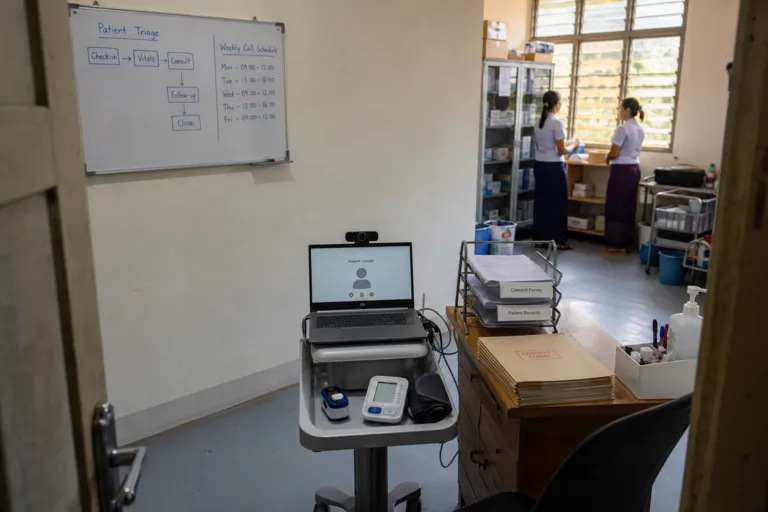
Telemedicine is the remote delivery of healthcare services such as consultations, exams, and monitoring through technology, including video calls, smartphones, and secure messaging. Industry reporting notes that telemedicine adoption accelerated during and after the COVID-19 pandemic, as remote care reduced travel needs and supported chronic care management. For the Myanmar digital health market, that basic value proposition matters because it directly addresses access constraints in rural regions and can save time and lower travel expenses. At the same time, broader adoption must also contend with trust barriers. One global industry report highlights data security and privacy concerns as a factor that can limit uptake, because they affect patient confidence in digital healthcare.
Comparative research on telemedicine use in Asian countries between 2018 and 2025 places Myanmar at the lower end of digital preparedness. The review reports that Singapore has a digital readiness index of +2.37 among ASEAN nations, while Myanmar has one of the lowest at -0.85. The same source states that broader implementation is limited in Bangladesh, Myanmar, and Nepal due to issues like unstable funding, poor governance, and restricted internet access. It also notes that in low- and middle-income settings such as Myanmar, inadequate infrastructure can exacerbate challenges. This context helps explain why adoption can be uneven even when telemedicine’s clinical model is straightforward.
What’s Already Working in Myanmar—and What It Signals
Despite constraints, Myanmar has a concrete example of scale-up. The same comparative study reports that the National Unity Government of Myanmar launched the Telekyanmar telemedicine initiative in June 2021 to provide remote medical aid. It states that Telekyanmar has expanded to 321 townships and enrolled over 71,000 people. Those figures show demand exists when services are organized and accessible. They also suggest that multi-township coverage is feasible even in a low-readiness environment, provided delivery is designed around the realities of connectivity and governance. For planners and operators, this kind of footprint becomes a practical reference point for building services that can be repeated and extended.
Regional market context also matters because it can shape vendor attention, product availability, and investment narratives. In the Asia-Pacific region, one market report values the telemedicine market at USD 18.48 billion in 2025, estimates USD 22.43 billion in 2026, and forecasts USD 105.82 billion by 2034, with a CAGR of 21.40% for 2026–2034. Another global report says the telemedicine market was valued at USD 86.59 billion in 2025 and is projected to reach USD 446.11 billion by 2034, with a CAGR of 19.98% from 2026 to 2034. These figures are not Myanmar-specific, but they signal sustained regional and global momentum that can influence what solutions are marketed and localized.
Policy and platform dynamics provide further signals for Myanmar’s next steps. A global report citing the World Health Organization (WHO) states that over 58% of countries have adopted national telemedicine policies to integrate digital health solutions into mainstream healthcare systems. That policy normalization can help set expectations on regulation and reimbursement, even if local readiness remains a constraint. On the product side, global reporting indicates that web-based delivery held 56.7% of the global telemedicine market share in 2024, pointing to the central role of browser-first and lightweight experiences in scaling access. For Myanmar’s digital health trajectory, the practical takeaway is to pair service rollout with trust-building and privacy-by-design, while choosing delivery modes that match real-world connectivity.
What does telemedicine mean in practice for patients?
How digitally ready is Myanmar compared with other ASEAN countries?
What is Telekyanmar and how far has it reached?
How does the Myanmar digital health market relate to Asia-Pacific telemedicine growth?
How common are national telemedicine policies globally?