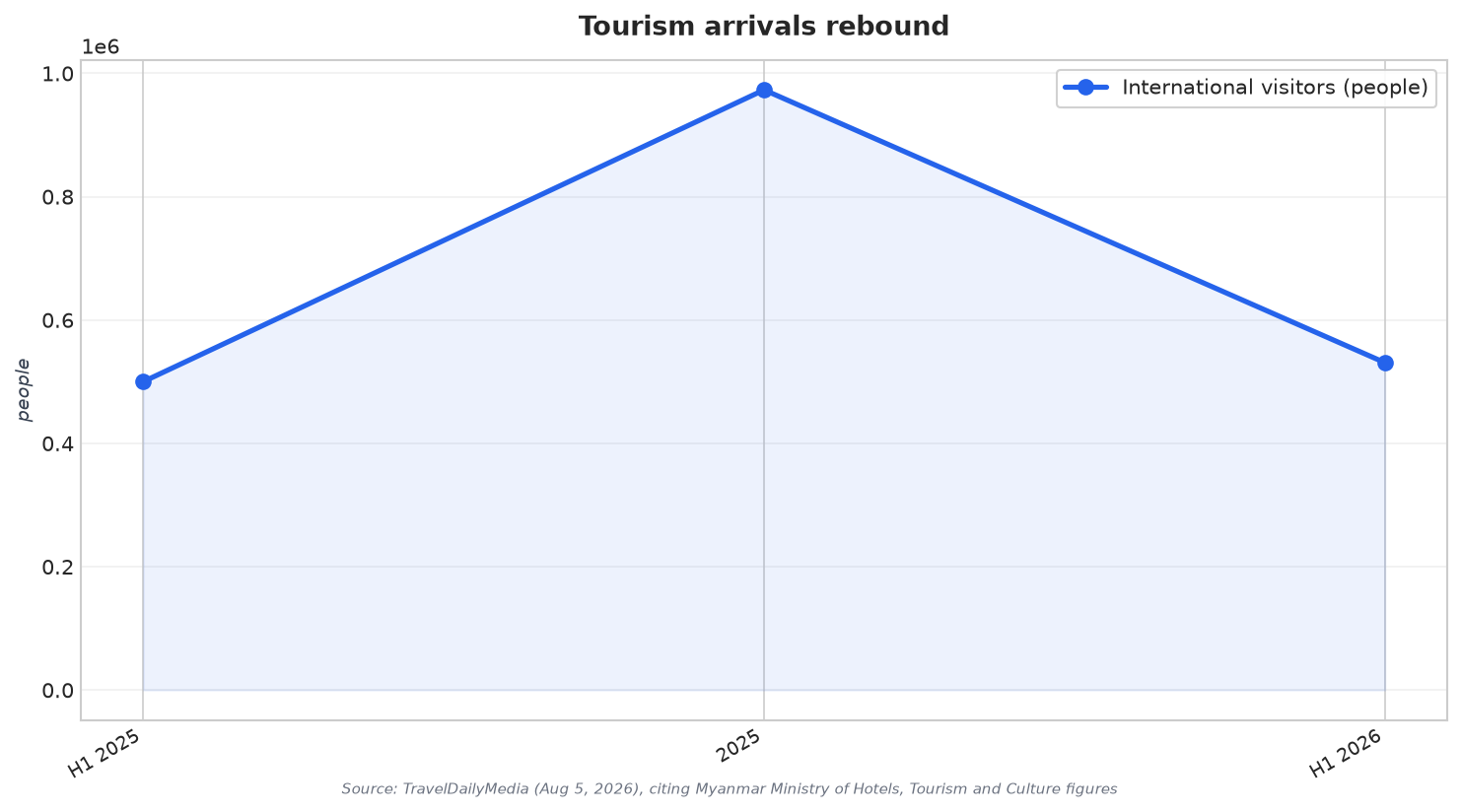
Myanmar’s tourism and hotel sector recovery in 2026 is best understood as a cautious rebound under pressure. Official figures cited by Travel Daily Media show 530,973 foreign visitors during the first half of 2026, up from 500,125 in the same period a year earlier. The same source stresses this does not amount to a conventional recovery, noting arrivals remain far below the 4.36 million recorded in 2019 and that large sections of the country are beyond the reach of mainstream tour operations. For airlines, hotel operators, and destination management companies, the operating reality in 2026 is shaped as much by security conditions and insurance constraints as by marketing and demand generation.
To plan realistically, it helps to separate what is working from what is missing. Travel Daily Media describes a market mix centered on nearby Asian demand rather than the long-haul touring circuits that once supported higher-value itineraries across Yangon, Bagan, Mandalay, and Inle Lake. It names China, Thailand, and South Korea as important sources of visitors, alongside cross-border business traffic, family travel, and Buddhist pilgrimage. The article also cautions that this mix carries different economics, with shorter stays, closer-in booking windows, and different spending patterns, so tourism income may not rise in line with arrival counts. In that environment, Myanmar tourism consulting work often starts with route-by-route feasibility and product design that matches the new visitor profile.
Hotels: Capacity Signals, Past Overbuilding, and Today’s Demand Reality
Myanmar’s accommodation landscape reflects a sharp shift from pre-crisis optimism to today’s uneven demand. A hotel and tourism statistics overview notes that tourist arrivals at Yangon airport were for many years between 200,000 and 250,000, then surged from 2012, with the pinnacle of high room prices reached in 2013. It adds that hotel conditions later improved due to the construction of numerous new accommodations, summarizing that the surge “led to a doubling and even quadrupling of hotel numbers,” before COVID-19 and the 2021 coup pushed tourism into decline and the 2025 earthquake “certainly” did not help. It also states Thailand land borders have been closed for international visitors since 2020, except the southernmost Kawthaung/Kawthoung crossing, which matters for border-dependent destinations and hotel occupancy planning.
At the regional level, capacity and product development are still being reported. Travel And Tour World cites tourism figures for the Ayeyawady Region saying hotels and guesthouses have expanded capacity, with over 5,000 accommodations offering more than 12,000 rooms. The same publication also references “over 973,000 foreign tourists in 2025,” aligning with Travel Daily Media’s report of 973,263 international visitors in 2025 and roughly 1.06 million in 2024, with the 2025 decline linked partly to weaker arrivals through land borders. Meanwhile, the hotel statistics overview highlights Yangon’s boom in luxury hotels, naming international five-star properties such as Melia, Pullman CenterPoint, Novotel, Savoy, Lotte, and Rosewood, and describing the higher-end positioning of Myanmar’s tourism base rather than mass tourism.
Entry logistics and digital touchpoints are functioning, even while travel advisories and security conditions complicate execution. Travel Daily Media reports that Myanmar’s official eVisa portal continues to accept tourism and business applications, with a standard tourist eVisa costing USD 50 and permitting a stay of up to 28 days, and requiring a passport with at least six months’ validity plus basic documentation. It also notes eVisa holders may enter only through designated airports and border checkpoints. Separately, Travel And Tour World describes QR-code travel guide keychains at Yangon and Mandalay airports as a tool intended to enhance the visitor experience. For 2026 programs, practical consulting priorities include aligning hotel contracting and itinerary design to the current source markets, confirming entry points permitted for eVisa travelers, and setting expectations that official targets—such as the government’s 1.8 million visitor goal for 2026 cited by Travel Daily Media—depend on a much stronger second half.
What do official figures show for Myanmar’s visitor trend in early 2026?
How did Myanmar’s 2025 and 2024 international visitor totals compare?
What does Ayeyawady Region capacity data suggest for hotel planning?
What are the key tourist eVisa terms travelers should know for 2026 planning?
What should Myanmar tourism consulting focus on in 2026?