
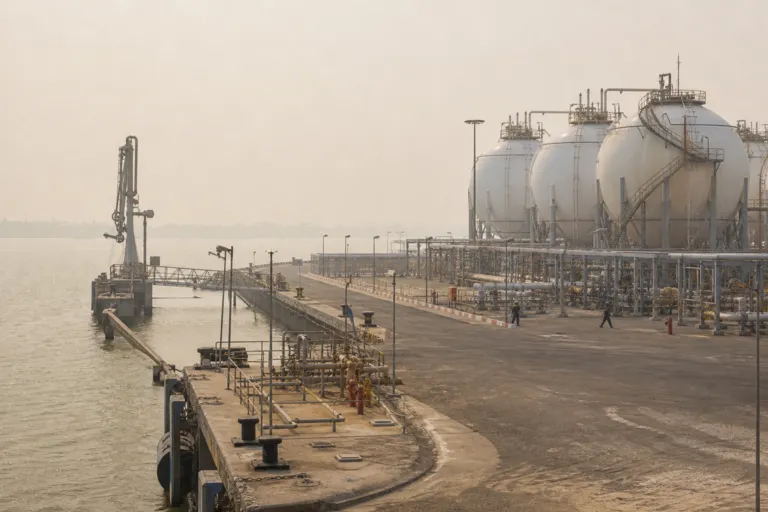
In 2026, Myanmar’s LPG sector sits at the intersection of household energy choices and a supply chain shaped by imports. One market report estimates that 85–95% of national LPG supply arrives by sea, which makes availability sensitive to foreign exchange access, shipping schedules, and regional pricing. The same source describes domestic commercial production as negligible at scale, so import arrivals and port-to-cylinder logistics largely set the market’s rhythm. This structure matters because LPG is a tangible, storable fuel used primarily for cooking, water heating, and small-scale process heat, yet its retail stability depends on trade and infrastructure more than local extraction.
Demand in Myanmar is led by kitchens. Household cooking fuel is estimated at roughly 55–70% of total LPG consumption, with commercial foodservice and small industrial users accounting for most of the remainder. This creates a base that the report calls resilient but price-elastic, especially when budgets tighten. Formal household penetration is still estimated at only 15–25%, a figure that implies meaningful runway for volume growth if affordability improves and if more households can access cylinders and consistent exchange services. The report also notes a gradual shift from traditional biomass and charcoal toward LPG in urban and peri-urban areas, supported by convenience expectations and intermittent grid electricity.
Distribution in 2026: Where Cylinders Move, and Where They Don’t
Distribution concentration is a defining trait of the Myanmar LPG market in 2026. One analysis estimates that Yangon and Mandalay corridors likely handle 60–75% of cylinder throughput, leaving secondary towns and rural areas underserved by formal networks. This imbalance shapes how demand can grow: expansion is less about changing the product and more about extending reliable dealer coverage, cylinder exchange points, and last-mile delivery capability. The same source observes that as price competition intensifies among importers and fillers, differentiation increasingly depends on dealer networks, cylinder exchange reliability, and credit terms rather than on product specification.
Price volatility is another key influence on 2026 demand growth because import financing and currency conditions can move retail prices quickly. The Myanmar-focused report warns that currency depreciation and import financing constraints can push retail LPG prices through 10–25% annual swings, disrupting household budgets and commercial margins. It also flags that port, storage, and cylinder-filling capacity is concentrated and vulnerable to logistics disruptions, which can create periodic tightness in upcountry markets. On top of that, regulatory oversight of LPG quality, cylinder safety, and filling standards is described as uneven, which can raise compliance costs for formal operators while enabling informal trade.
Global context helps frame what Myanmar is trying to capture in cooking-led demand. Multiple global reports point to residential and commercial cooking as a major part of LPG use, including estimates of 45.20% in 2025 (Mordor Intelligence) and 48.4% in 2025 (Market Research Future). Meanwhile, global market forecasts vary by publisher, such as a 4.60% CAGR for 2026–2031 (Mordor Intelligence), 4.95% for 2026–2035 (Market Research Future), and 3.7% for 2026–2033 (Grand View Research). These figures are global, not Myanmar-specific, but they underline that cooking demand remains a core anchor. For Myanmar, the near-term growth lever in 2026 is practical execution: widening distribution beyond the main corridors while managing import sensitivity, logistics bottlenecks, and price swings that can slow refill behavior.
How import-dependent is Myanmar’s LPG supply in 2026?
What share of Myanmar LPG demand comes from household cooking?
Where is cylinder distribution most concentrated inside Myanmar?
What is the estimated formal household penetration in Myanmar, and why does it matter?
What is changing most in the Myanmar LPG market: product quality or service delivery?